
If you’re a regular reader of the “Curatorial Corner,” you know that many organizations and individuals have stepped forward to help us tell the story of American music. Every loan represents not only an extraordinary object, but also a shared commitment to preserving our nation’s musical heritage.
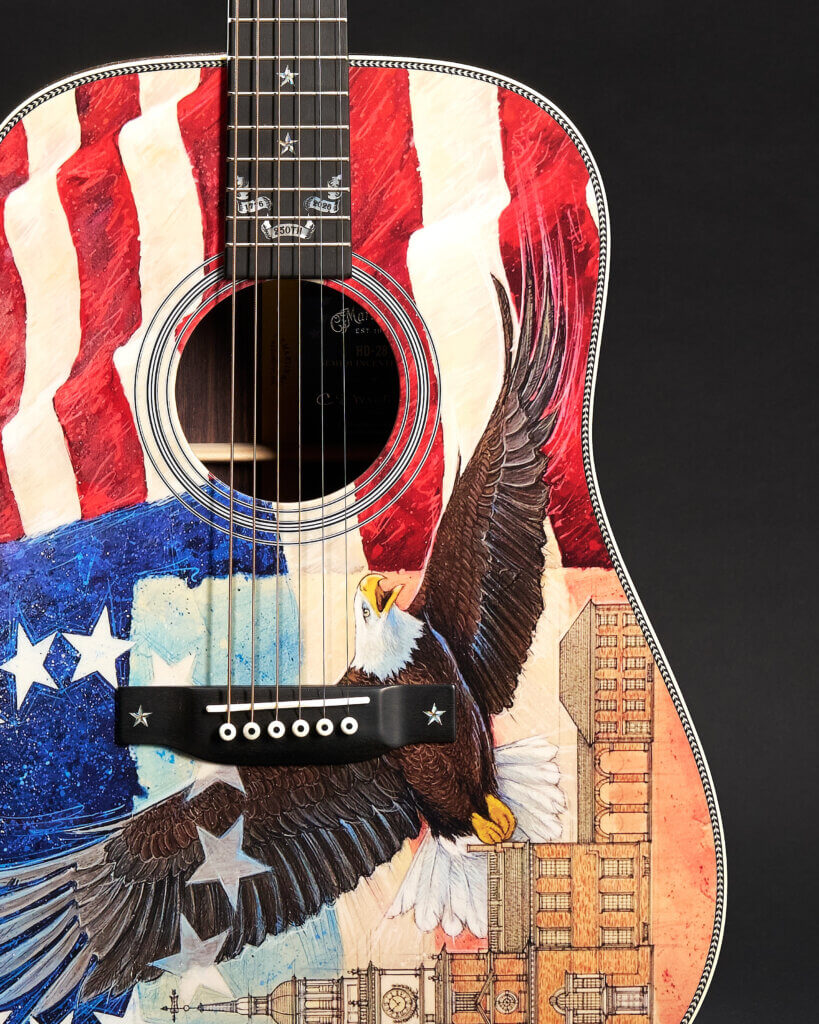
Among the loans in our Chimes of Freedom exhibit is a striking custom-built guitar generously loaned by C. F. Martin & Company. Created to commemorate the 250th anniversary of the United States, the instrument is itself a work of art. Its design evokes iconic American imagery—the flag, the bald eagle, and Independence Hall—symbolizing the enduring relationship between music and the American experience.
At first glance, the guitar might seem like just a contemporary commemorative piece. But it also tells a much deeper story.
Founded in 1833, C. F. Martin & Company is one of America’s oldest and most influential instrument makers. For nearly two centuries, Martin guitars have helped shape the sound of American music. Their instruments have been embraced by generations of musicians across genres—from folk, country, bluegrass, blues, and rock to singer-songwriters whose music has chronicled the nation’s triumphs, struggles, and aspirations.
That legacy makes Martin a natural fit for Chimes of Freedom. Throughout the exhibition, visitors encounter artists who used music to challenge injustice, build community, and give voice to ordinary Americans. Again and again, Martin guitars appear in those stories—not because of corporate sponsorship or marketing, but because musicians chose them as trusted companions in moments that became part of our shared cultural history.
We recently caught up with Jason M. Ahner, Archives & Museum Manager at C. F. Martin & Company, to learn more about the remarkable history of the company, the significance of this special instrument, and why preserving the history of guitar making matters. Here’s what he had to say:
For readers who may not be familiar with Martin Guitar’s remarkable history, could you tell us a bit about the company’s origins and how it has evolved over nearly two centuries?
Martin Guitar was founded in 1833 by C.F. Martin, Sr. He studied guitar building in Vienna, Austria where he eventually met his wife, Ottilia. After the birth of their first child C.F. Martin, Jr. they moved to Martin’s hometown of Markneukirchen, Germany. The restrictive guild system in Germany was one of the main reasons the Martin family made the decision to immigrate to the United States. Originally based on the lower west side of Manhattan, Martin built guitars and ran a successful retail shop in these early years. The Martin family moved to the Nazareth, Pennsylvania area in 1839. This move was pivotal in the evolution of guitar design because it allowed Martin the freedom to focus on just guitar building without the interruptions the retail store might have caused him. Using the influences from the guitars he learned to build in Vienna combined with the Spanish built guitars he became familiar with in New York City, C.F. Martin, Sr. created what is now considered the first truly American guitars.
Martin guitars have become synonymous with American music. What do you think has made the company such an enduring presence across so many genres and generations of musicians?
I believe the innovative nature of the company is one of the main reasons why Martin Guitar has such longevity. Inventions like X-bracing, the Dreadnought and Orchestra Model as well as the tone our guitars achieve are why countless musicians have turned to them for almost 200 years. Another factor is Martin is always taking into consideration what guitar players want. That’s part of the reason why our designs have evolved throughout our history because the perfect guitar 100 years ago isn’t the perfect guitar today.
The guitar you loaned to Chimes of Freedom was created to commemorate America’s 250th anniversary. Can you tell us about its design and the symbolism incorporated into the instrument?
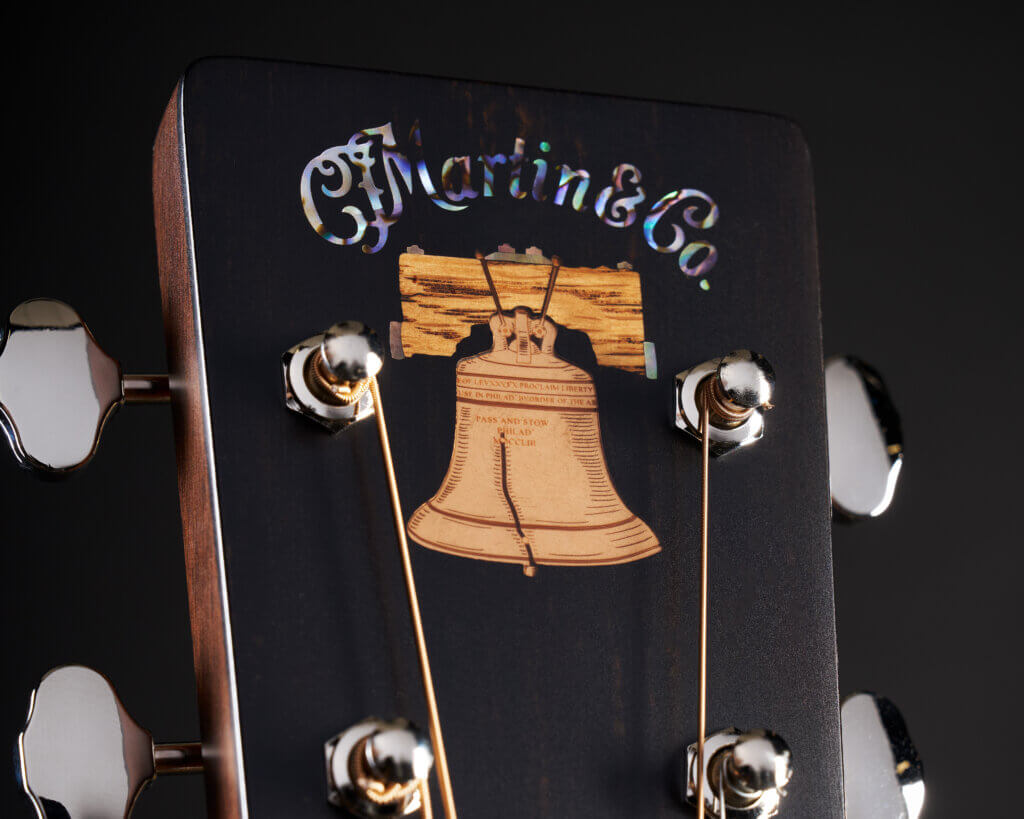
The HD-28 Semiquincentennial was created to celebrate a couple of milestones. The first is the 50th Anniversary of our HD-28, which is the platform for the model. The second is the 250th birthday of the United States. It features artwork by our resident artist Robert Goetzl. The artwork illustrates the Betsy Ross flag, Philadelphia’s Independence Hall as well as our national bird, the Bald Eagle. The artwork is printed on the spruce top of each model. In addition, the headplate features an inlaid Liberty Bell and the yoke that it hangs from is made of wood from the Basking Ridge Oak Tree. During the Revolutionary War, this white oak served as a drill area for the Continental Army, as well as a picnic location for George Washington who was joined there by the Marquis de La Fayette.
How did the idea for this commemorative guitar come about, and what did Martin hope it would represent?
Milestone guitars have been a part of our history for decades. Normally we build a special model to commemorate a specific serial number, like serial numbers 1,000,000, 2,000,000 and 3,000,000 that are on display in our museum. Other guitars are built for a specific occasion like the D-76 Bicentennial model built in 1976 to celebrate the 200th birthday of the United States. With that in mind we wanted build a guitar that captured some of the early elements of the United States but at the same time we wanted it to be something that would also be a modern tribute to one of our most popular guitars, the HD-28. It was important for us to create a model that not only served as a piece of art but also give the playability and tone Martin guitars are famous for.
Martin maintains a rich corporate archive. What kinds of materials are preserved there, and why are they important?
Our archives not only represent the history of our company but also the history of the Martin family. The oldest document in our archives is C.F. Martin, Sr.’s father Johann Georg Martin’s baptismal certificate from 1765. We also have some of the earliest forms, fixtures, and tools used to build early Martin guitars. In all there are hundreds of thousands of items located in our archives. We have correspondence and sales ledgers dating back to 1830s shortly after C.F. Martin’ Sr.’s arrival to the United States. From them we can get an idea of how the business was run during this early period. Our archives also serve as a great resource for historically inspired models where we can take a look back and see how guitars were built during a specific period in our company’s history. In addition, since we have an in-house repair department that works on everything from when the company was founded up until now, our archives can be used as a guide for vintage and antique models that need restoration.
Are there particular instruments or archival discoveries that have especially fascinated you during your time with the company?
There are so many items in our archives that fascinate me but there are a couple that definitely come to mind. During my time as archivist for the company, I found some handwritten notes from C.F. Martin III, who was the great-grandson of C.F. Martin, Sr. He served in various roles with the company from the 1910s until 1986. While doing some research in the archives I found a binder of his that featured notes about a couple of subjects that have been debated for years. The first was string gauges on vintage Martin guitars. I was able locate a note from 1946 that gave the specific gauges that Martin was using when steel string guitars became standard replacing the gut string models the company had been building for almost a century. The second note focused on the bracing pattern used on guitars. Martin is famous for X-bracing, and the note gave the specific date in 1957 when the position of the braces was changed on Dreadnought models.
Martin guitars have been played by everyone from folk singers and country musicians to rock legends. Are there artists or moments in music history that you think best illustrate the company’s impact on American culture?
There are some that definitely come to mind like Jimmie Rodgers recording what is now considered some of the earliest country music records on a Martin guitar. There’s also Joan Baez performing in 1963 on her 1929 0-45 at the March on Washington. Geroge Harrison playing a D-18 in San Francisco’s Golden Gate Park in 1967 during the Summer of Love. Kurt Cobain playing his 1959 D-18E on MTV Unplugged. And Eric Clapton and John Mayer playing their signature models on Larry King Live in support of aid for the victims of Hurricane Katrina. This is just a small glimpse of so many monumental moments in music history that Martin Guitar has been a part of.
Our exhibition explores the ways music has reflected American identity and social change. How do you think instrument makers like Martin contribute to that story?
I believe that instrument makers like Martin help to create another layer of the message being portrayed. Obviously, words are extremely important, but when they become lyrics and are set to music, they can reach a whole new level. Music is such an important part of our lives and through it we can express thoughts and emotions that we might not be able to in another form.
Why do partnerships between museums, archives, and companies like Martin matter when it comes to preserving America’s musical heritage?
In the grand scheme of things, we are a small company located in a small town. By working with other institutions, we can help promote the importance of how American music has influenced our culture since our country was founded. From the battlefields of the Civil War to Occupy Wall Street music has served as a driving voice to inspire and as reassurance that a better way is possible. By preserving and sharing the history of American music intuitions like the Martin Archives and the Springsteen Center can collaborate to reach a much broader audience and illustrate the impact music has made.
As the United States celebrates its 250th anniversary, what do you hope visitors take away when they encounter this guitar in Chimes of Freedom?
My hopes are that visitors will appreciate the freedom of expression that has been the backbone of our country for the past 250 years. The ability to speak your mind and be a champion for change is an integral part of the American experience.
Finally, what exciting projects or initiatives is Martin Guitar currently working on that history and music enthusiasts should know about?
Right now, we are working on a project called “Project 91” where we are recreating the original 91 pre-war D-45s built between 1933-1942. Pre-war D-45s are arguably the most collectible acoustic guitars ever made. By being able to look at our archives for inspiration and by having the records available from that period we can get as close to as possible to the originals. It is the perfect blend of history and many of the modern building techniques we use today.
From your perspective, what has Martin’s relationship with artists like Springsteen meant to the company’s history, and what do those artists contribute to Martin’s legacy?
The fact that artists like Bruce Springsteen have used Martin guitars to help create their art I think further cements our legacy as America’s premier guitar builder. Martin guitars have been played by so many legendary artists across every genre of popular music that their sound is ingrained in the American musical landscape.
Melissa Kozlowski
Director of Curatorial Affairs
Bruce Springsteen Center for American Music
Monmouth University
July 28, 2026