Seven years ago this week, on September 28, 2019, we gathered in Freehold for the opening celebration of Springsteen: His Hometown, an exhibition co-curated by what was then the Bruce Springsteen Archives and Center for American Music at Monmouth University and the Monmouth County Historical Association.
Looking back from where I sit today, in our new 30,000-square-foot Bruce Springsteen Center for American Music, it is remarkable to think about how much began with that exhibition.
When the Springsteen collection first came to Monmouth University in 2011, a call went out to faculty asking us to think about ways we might engage with it. As a full-time faculty member in the Department of History and Anthropology and a public historian who had spent my career thinking about archives, museums, material culture, and how we make history accessible to the public, I jumped at the opportunity.
I began incorporating the collection into my classes, developing projects that allowed students to work with archival materials and think about how those materials might be interpreted for audiences beyond the classroom. I have always believed that public history is best learned by doing it. Students can certainly read about collections management, exhibition development, research, interpretation, and label writing, but there is nothing quite like letting them conduct an oral history interview themselves, or putting an actual object in front of them and asking: What story can we tell with this?
One of those projects, undertaken by my Fall 2018 Museums and Archives class, resulted in a small exhibition in the Monmouth University Library. The response was tremendous.
And it got me thinking.
I had friends and colleagues at the Monmouth County Historical Association, which happened to have a wonderful exhibition space in the heart of Freehold. The Springsteen Archives had an extraordinary (and growing) collection, but no dedicated exhibit space. What if we brought these entities together?
I approached Linda Bricker and Chuck Jones, on the Board of the Historical Association, and Bob Santelli and Eileen Chapman at the Archives, with the idea of collaborating on a larger exhibition. Everyone enthusiastically agreed. Bernadette Rogoff, then the Historical Association’s director of collections, and I became co-curators, with Bob and Eileen serving as advisors. Special thanks are owed, too, to Meg Sharp Walton on the Historical Association side.
That idea ultimately became Springsteen: His Hometown, the first traveling exhibition produced by the Center.
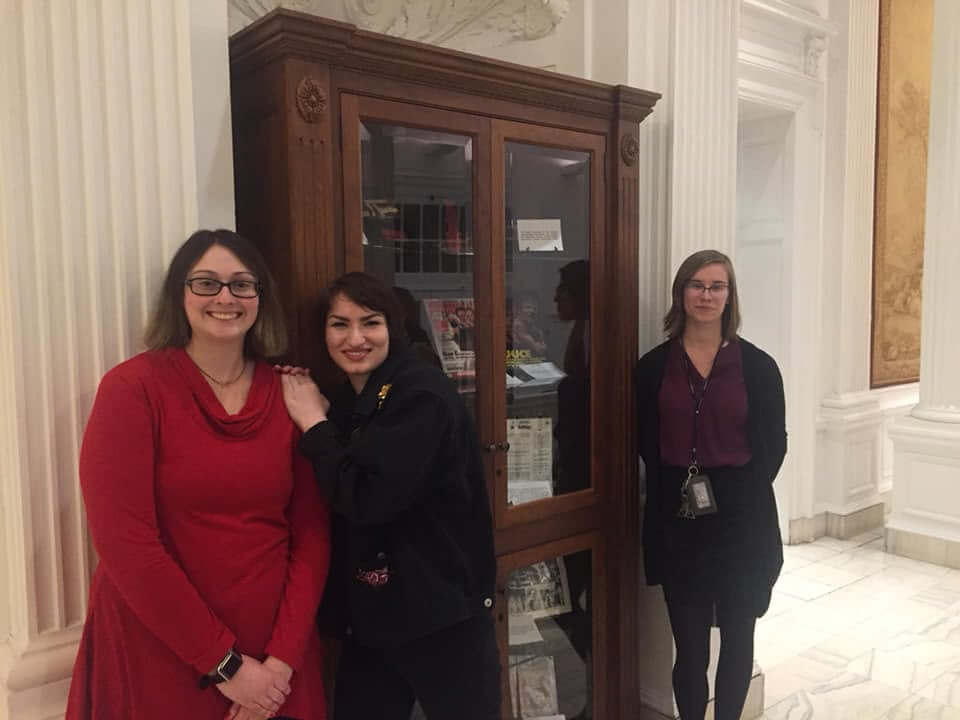
Then-students Stephanie DeLaat, Graciela St. Onge (now the Center’s archivist), and Hayley Branstrom at the opening of our class exhibit at the Guggenheim Memorial Library at Monmouth University, December 2018.
More Than a Rock & Roll Exhibition
From the beginning, we wanted His Hometown to be more than a display of rock & roll memorabilia.
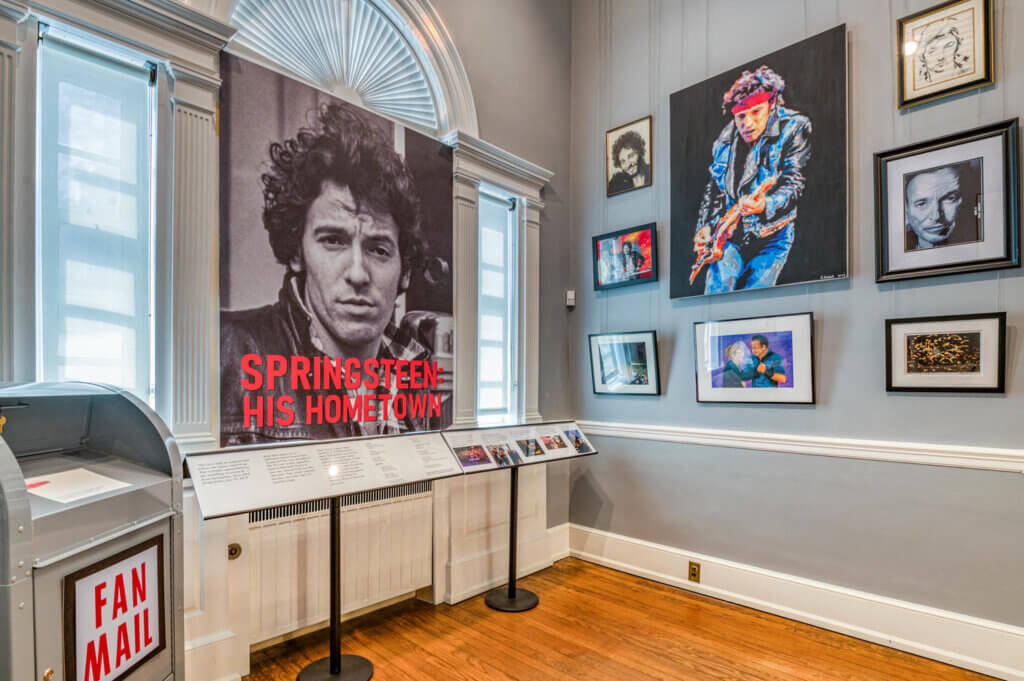
There were certainly plenty of objects that would make any Springsteen fan stop in their tracks. The exhibition included roughly 150 items drawn primarily from the collections of the Springsteen Archives and the Monmouth County Historical Association, supplemented by objects borrowed from Bruce and others in the community.
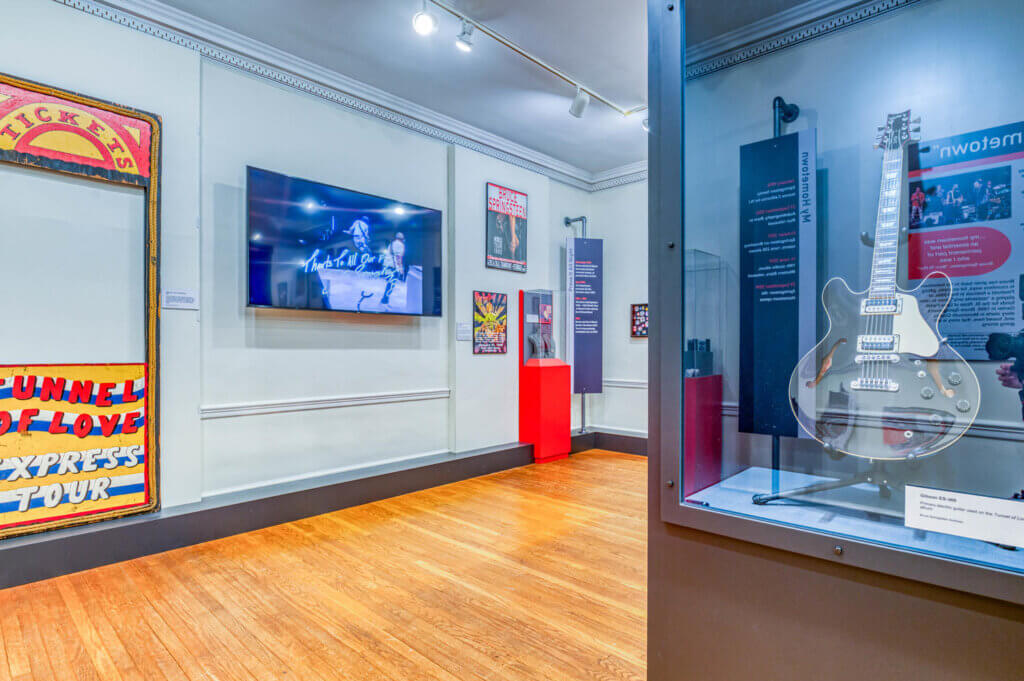
There were guitars and clothing, as one would expect. Concert posters advertised early bands including the Castiles and Steel Mill. Visitors could see a piece of the wall from the legendary Upstage Club in Asbury Park. There were alternate album covers, a carnival ticket booth used during the Tunnel of Love tour, correspondence, photographs, fan-created artwork, and even a collection of hotel keys accumulated during years on the road.
One of my favorite objects was a scrapbook lovingly assembled by Bruce’s mother, Adele, documenting her son’s career.
Some of these very items are now on display in our new Center.
It was a wonderful reminder of something that museums do particularly well. An object does not have to be monumental to be meaningful. Sometimes the most ordinary object can tell the most human story.
But His Hometown was never intended simply to chronicle the career of a famous musician. The title was chosen for a reason. We wanted to explore the relationship between Bruce Springsteen and the place that made him.
The Ties That Bind
The physical layout of the Monmouth County Historical Association gave us an opportunity to make that distinction particularly clear. The first floor concentrated more heavily on Bruce’s musical career and the artifacts associated with it.
As visitors moved upstairs, however, the story widened. That second-floor section looked deeply at Springsteen’s family, Freehold, and the generations of history that preceded his birth.
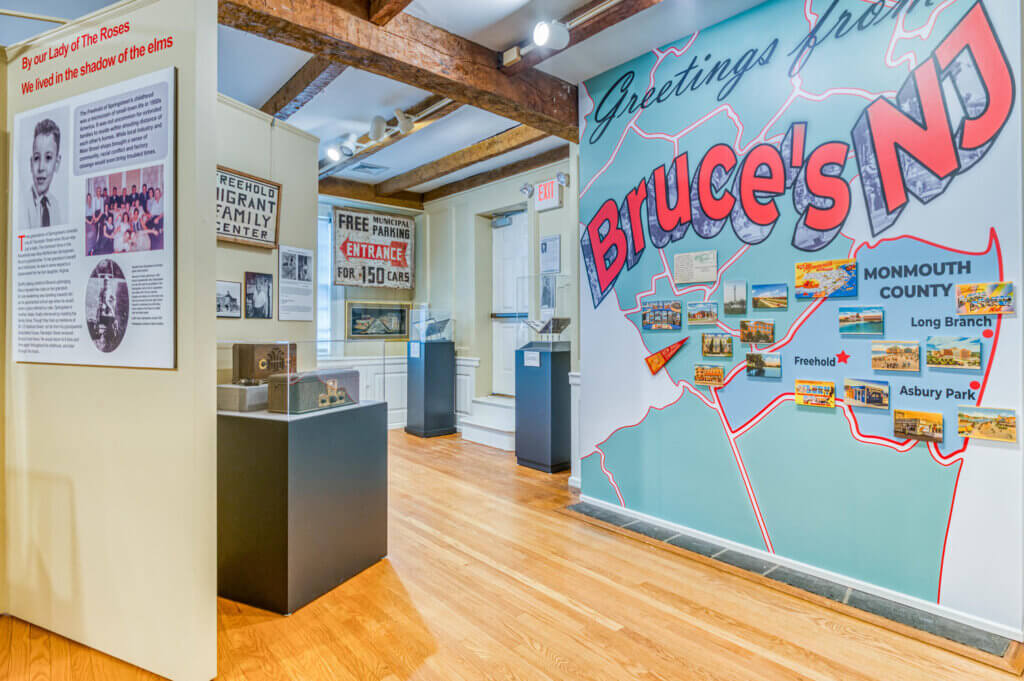
Visitors encountered a Springsteen family tree stretching back centuries. Among the objects were an 1801 document signed by John Springsteen, Bruce’s direct ancestor and a veteran of the American Revolution, as well as a nineteenth-century document connected to Alexander Springsteen, who served in the Union Army during the Civil War. The exhibition traced the family’s roots in America back even further, to Joost Casperse Springsteen, who arrived from the Netherlands in 1652.
We also explored the more immediate family story.
Adele Springsteen was represented not just as “Bruce Springsteen’s mother,” but as a person with her own history. Her 1943 high school yearbook was among the objects on display, as was the scrapbook she kept of her son’s career. The exhibition discussed her work as a legal secretary and her role as an important source of stability for the Springsteen family. Bruce’s father, Douglas, and the complicated relationship between father and son that would later become such an important element of Springsteen’s songwriting were part of the story as well.
In fact, one contemporary account called Adele the exhibition’s “surprise star,” and I love that observation (not just because I’m a mother myself, but) because it speaks to something we were consciously trying to accomplish. We didn’t want the people surrounding Bruce to appear simply as supporting characters in the story of a famous musician. They had histories of their own. Adele was a daughter, student, working woman, wife, and mother whose life was shaped by a particular time and place, and whose experiences, personality, and influence became part of Bruce’s story as well.
That is one of the things I love most about public history: widening the lens. When we do that, a story that initially appears to be about one extraordinary individual becomes a story about families, communities, work, class, gender, place, and the experiences of generations of ordinary Americans.
There were wonderfully personal glimpses of Bruce himself, too. George Theiss’s high school yearbook contained a handwritten message from his fellow Castiles bandmate. We displayed one of Bruce’s own school assignments, a report on the New Jersey judicial system (for which the future chronicler of the American experience earned a B).
Those kinds of objects mattered because the exhibition was ultimately about context.
Freehold was not simply the place where Bruce Springsteen happened to be born. Its neighborhoods, churches, schools, factories, streets, families, economic changes, and contradictions became part of the vocabulary through which he understood, and eventually wrote about, the world.
That is a public historian’s dream.
Popular music becomes another kind of primary source: a way into discussions of work, class, family, race, religion, community, mobility, identity, memory, and the changing American landscape.
Opening Night
The September 28 preview party, called “Dancing in the Dark,” sold out quickly. Joe Grushecky & the Houserockers had the audience on their feet.
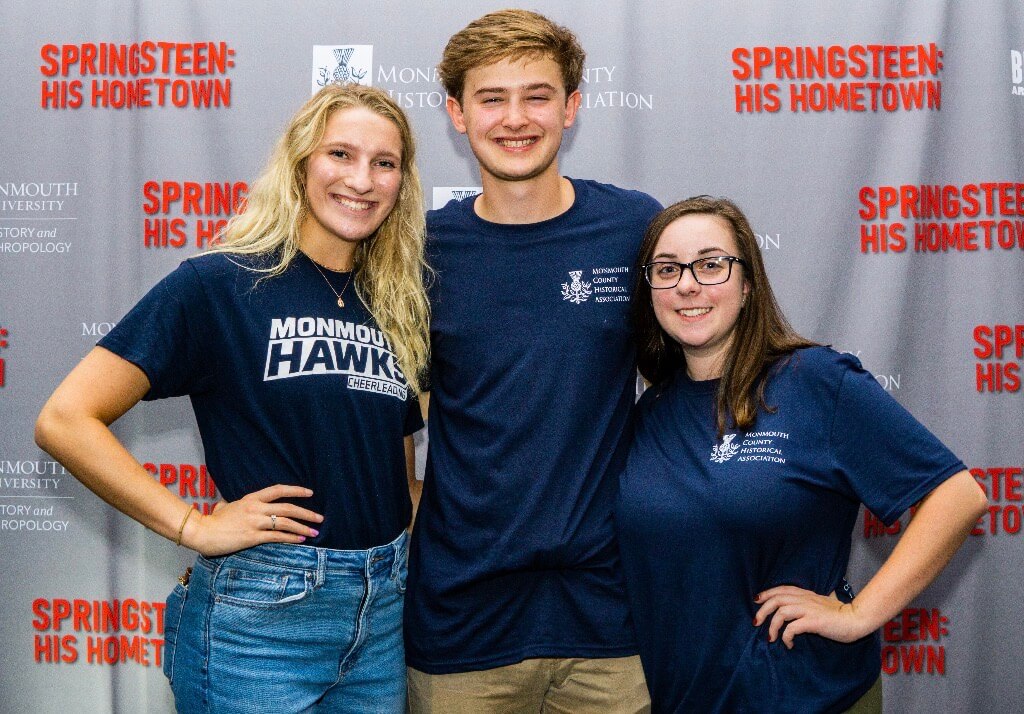
Then-students Annalaan LeMay (now the Center’s Social Media and Marketing Manager), Connor Rupp, and Gillian Demetriou at the opening festivities.
And then Bruce showed up.
He toured the exhibition we had created about his life, his family, and his hometown, and joined Joe Grushecky and the Houserockers onstage for “Light of Day.”
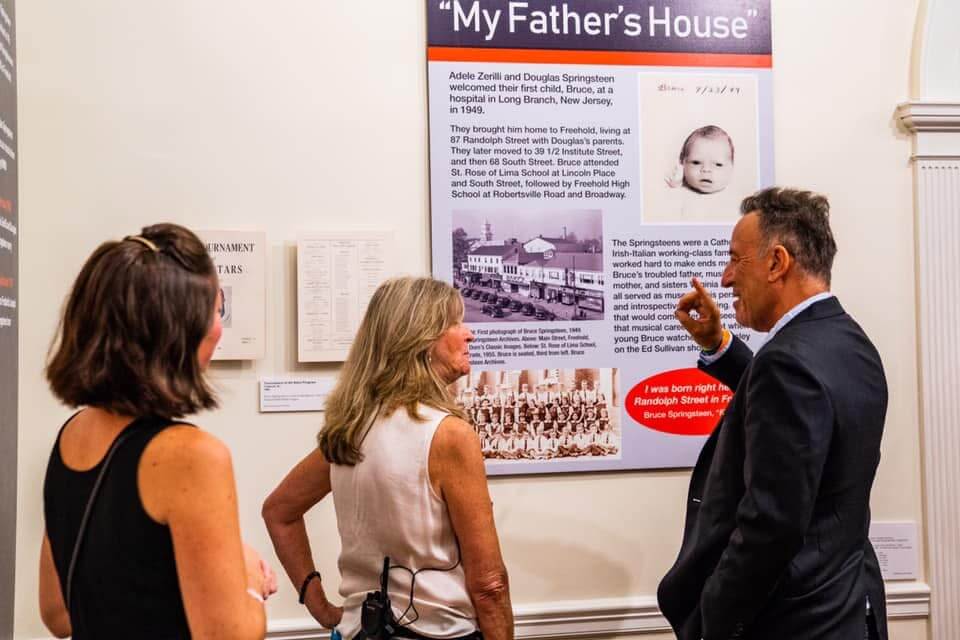
Bruce touring the exhibit with Melissa and Eileen.
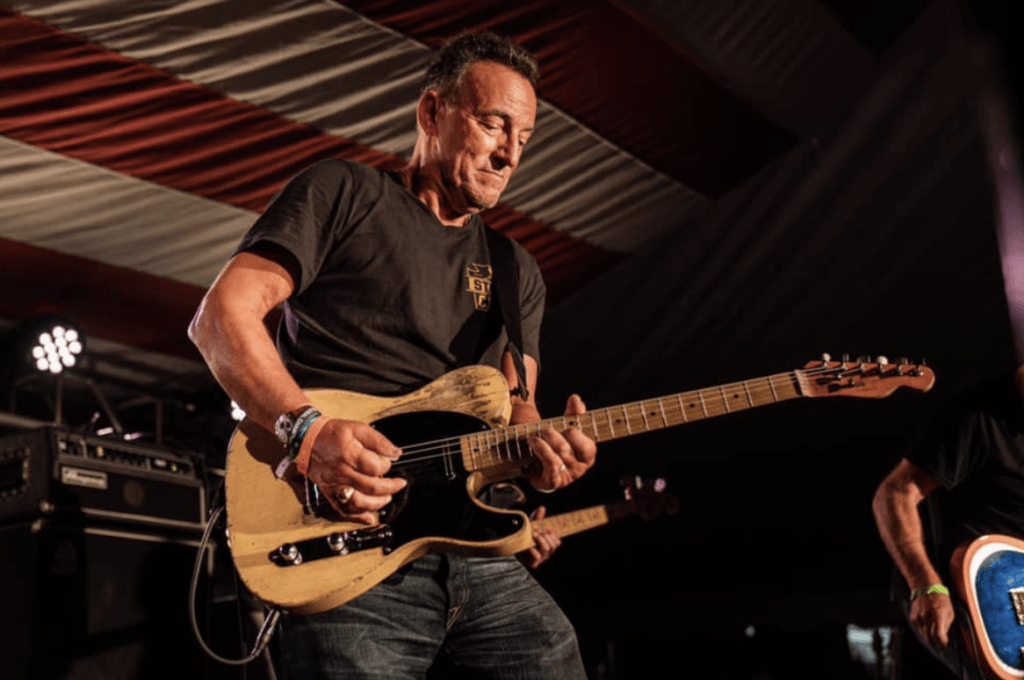
Bruce performing at “Dancing in the Dark.” Photo by Michael Kravetsky.
For a historian and curator, there is something wonderfully surreal (if nerve-wracking) about walking someone through an exhibition in which they are the historical subject.
The exhibition opened to the public the following day and quickly attracted attention well beyond Monmouth County. Coverage appeared locally and nationally, and writers seemed particularly interested in the fact that His Hometown wasn’t simply a celebrity exhibition. It used Springsteen as a lens through which to explore family, place, community, and history. One contemporary review observed that the exhibition illuminated where Springsteen came from in a way that had not really been done before.
That was exactly what we hoped it would do.
From a Classroom to a Center
Seven years later, we are a few months into opening our new Center for American Music, where we preserve and interpret not only Bruce Springsteen’s legacy, but the much broader history of American music. We create permanent and temporary exhibitions. We develop traveling exhibitions. We welcome researchers, students, teachers, fans, families, and visitors from around the world.
In many ways, the philosophy behind His Hometown is still the philosophy behind what we do today. Objects matter, but the stories they allow us to tell matter more. Music matters, but so do the historical forces that produced it. And the story of an internationally known artist can also be the story of a family, a factory, a neighborhood, a town, a state, and ultimately a country.
There is another lesson in this anniversary that I particularly love as an educator. Springsteen: His Hometown did not emerge from a strategic plan or a mandate. It grew organically out of teaching, collaboration, curiosity, and a willingness to ask, What else could we do with this collection?
Seven years later, I can walk through the galleries of the Bruce Springsteen Center for American Music and see some of those same principles at work on a much larger scale.
There is something wonderfully full-circle about that. What began with a collection, a classroom, and a question became an exhibition, and that exhibition became the first of many opportunities for us to explore American history through music and the people, places, and communities that create it.
We have a much bigger building now. We have more objects, more exhibitions, more programs, and many more stories to tell. But I hope we never lose the curiosity that was at the heart of Springsteen: His Hometown.
Because seven years later, I think the best question we can still ask of any collection is the same one we asked then:
What else can we do with this?
Melissa Kozlowski
Director of Curatorial Affairs
Bruce Springsteen Center for American Music
Monmouth University
September 29, 2026