One of my favorite things about working at the Bruce Springsteen Center for American Music is that you never quite know what will arrive next. Sometimes it’s a handwritten lyric. Sometimes it’s a concert poster. Sometimes it’s an instrument with a remarkable story attached to it. And sometimes, it’s a painting.
Recently, producer Ron Aniello donated a work of art that now hangs in our Archives reading room. If Aniello’s name sounds familiar, it’s because he has played a significant role in Bruce Springsteen’s creative life for more than a decade, producing albums including Wrecking Ball, High Hopes, Western Stars, Letter to You, and Only the Strong Survive.
We often think of musicians and producers in terms of sound. We know them through records, concerts, lyrics, and performances. Yet creative people rarely confine themselves to a single medium. The same imagination that helps shape a song can emerge through a camera lens, a sketchbook, or, in Aniello’s case, a paintbrush.
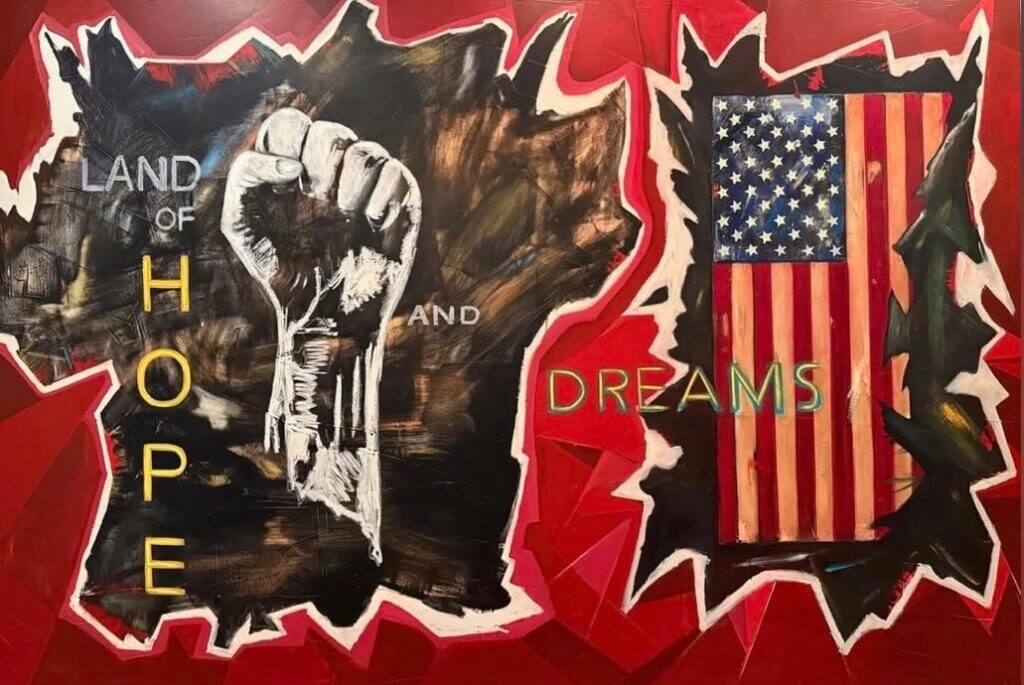
The painting, titled Land of Hope and Dreams, now welcomes researchers and visitors to our Archives area. Inspired by one of Springsteen’s most enduring songs, it serves as a reminder that music’s influence extends far beyond what we hear. Songs inspire visual art, visual art inspires music, and both help us make sense of the world around us. Aniello recently noted that the work is now on view at the Center, sharing it with fans through his social media.
As a curator, I love objects that challenge expectations. A producer’s painting certainly does that. But perhaps it shouldn’t. After all, the story of American music has never been just about music. It’s also a story about creativity itself. That’s why, in our Jon Landau American Music Gallery, we have a whole section dedicated to the intersection of music and art. It features sheet music, a Lady Gaga costume, and a John Mellencamp painting! But more on that another day.
For now, let’s hear from Ron himself:
When did you start painting, in general?
I’ve been drawing my whole life, but I didn’t start painting until 2022 when I moved to Middletown, NJ. I had a new house, the walls needed art, and I didn’t want to just buy something off the shelf. So I put together a studio and taught myself.
When did you paint this piece, and what was happening in your life or in the world at the time?
I painted Land of Hope and Dreams in late March 2026. The inspiration was the message Bruce was relaying to his audiences at that time – I was proud of him for amplifying what so many Americans were feeling, and I wanted to contribute in my own way.
Why did you choose these particular visual elements — the raised fist, the American flag, and the torn or fractured shapes surrounding them? What do those symbols represent to you individually and collectively?
Bruce and Patti had previously selected some of my artwork for the tour: a poster of the fist, an American flag used for a bandana, and a sketch for the No Kings patch. I had a large canvas up at the time and decided to try and bring the fist and flag together in one painting.
I wanted the fist to convey the sensation of power breaking through boundaries, and the flag to feel fractured — like broken glass. If you look closely, there are several subtle shades of red near the flag. Together, I hope this suggests the idea of using our collective strength as a unified presence — to protect a democracy that was being pushed to its limits.
Did the work evolve during the painting process, or did you begin with a clear vision?
My initial sketches and early versions had the lyrics from the bridge of the song — this train… — scrawled across the face of the flag. But as a visual piece, it felt cluttered, and I also wasn’t comfortable covering the flag that way. I did some research on flag etiquette and learned a few things I hadn’t known — for instance, if the flag is oriented downward, the stars need to shift to the left. Small details, but they mattered to me.
Why did you choose to place this work at the Bruce Springsteen Center for American Music? What do you hope researchers, students, and visitors will take away from it?
It felt like the only home for it. It’s a large-scale work and somewhat different from my other paintings. I sent a photo to Jon Landau to get his opinion, and he set things in motion from there. I’m grateful it will be seen by people who can appreciate the context. My hope is that it might inspire someone the way art has always inspired me. The style I paint in is Neo-Expressionism — art that expresses a story or carries a point of view. I’d love for a student to see that those possibilities exist in any form of art — that a painting can deliver a message, rather than simply reflect images back at the viewer. Artists like Jean-Michel Basquiat and Keith Haring were geniuses at that.
Have Bruce or members of the E Street Band seen the painting? If so, what was their reaction?
They haven’t seen it yet — and honestly, how do you show a nearly ten-foot-wide painting to someone? At some point, they’ll wander into the archives and find a surprise. I look forward to that moment.
The word “HOPE” seems to be given particular visual emphasis. Why?
Because hope is the word that draws emotion. Dreams is larger as well. The other words are more incidental. I wanted those two words to soften the anger and fragility in the imagery — to give the painting somewhere to land.
If visitors spend just thirty seconds with this painting, what’s the one thing you’d like them to notice or think about?
I’d want them to be reminded that Bruce Springsteen, in 2026, stood up and said something — at a moment when others were silent, when the rights of American citizens and our immigrant community were being stripped away. He did it with words like hope, and with his music. We recorded “Streets of Minneapolis” in two days. It spoke directly to the moment, as did the tour. I hope the painting reflects that same urgency.
You can see more of Ron’s work at the opening of his new show, AMPLIFY, on Wednesday, July 1, 2026 from 7:00 PM 9:00 PM at AH Arts, 54 First Avenue, Atlantic Highlands, NJ. See more here.
Melissa Kozlowski
Director of Curatorial Affairs
Bruce Springsteen Center for American Music
Monmouth University
June 16, 2026