
When Olivia Rodrigo announced her new music festival, Daisy Chain Fields, this week, it felt both fresh and familiar. Inspired in part by Lilith Fair and designed to celebrate women artists, community, and social change, Daisy Chain Fields joins a long tradition of festivals that have sought to be about more than music alone.
In many ways, the story of the modern music festival began nearly sixty years ago at the legendary Monterey International Pop Festival.
Held in June 1967, Monterey Pop brought together an extraordinary collection of artists including Janis Joplin, Otis Redding, Ravi Shankar, The Who, and Jimi Hendrix. More than simply a concert, Monterey introduced audiences to new sounds, cultures, and ways of thinking. It helped launch careers, demonstrated that rock music could be taken seriously as an art form, and became one of the defining events of the Summer of Love.
Monterey also established a template that would echo through the decades. Festivals could be places where music intersected with social movements, where diverse artists shared a stage, and where audiences experienced a sense of collective identity. The event’s motto—”Music, Love, and Flowers”—captured a vision that extended well beyond entertainment.
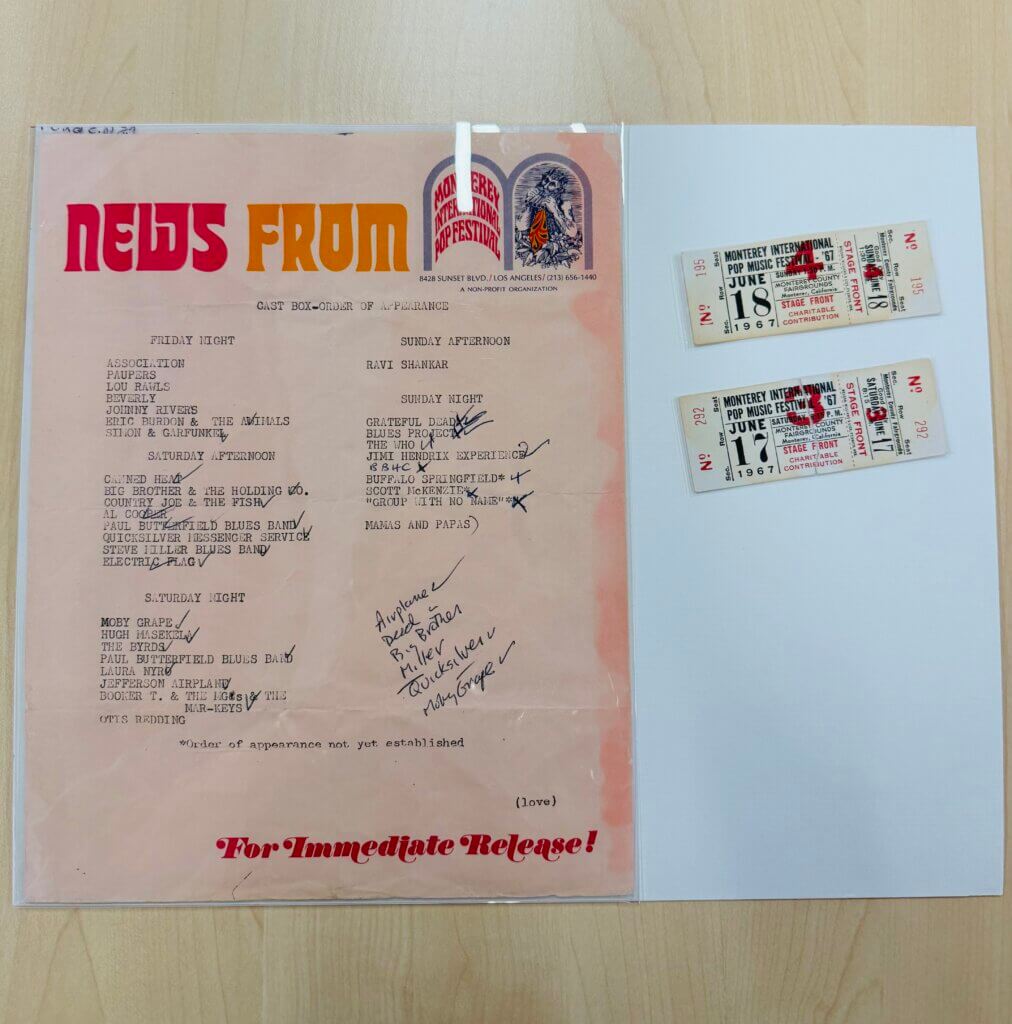
Monterey Pop materials currently being mounted for inclusion in a new exhibit—stay tuned for more on this!
Two years later came Woodstock, the festival that would become synonymous with a generation. In the decades that followed, festivals evolved alongside American culture itself. Some, like Farm Aid, focused on specific causes. Others, such as Lollapalooza and Bonnaroo, reflected changing tastes, technologies, and business models. Music festivals became destinations, cultural touchstones, and increasingly powerful platforms for activism and identity.
One particularly important chapter arrived in 1997 with Lilith Fair. Created by Sarah McLachlan, the traveling festival challenged the industry’s assumption that women artists could not successfully headline major concert events. Featuring performers such as Sheryl Crow, Tracy Chapman, and Jewel, Lilith Fair demonstrated not only the commercial power of women performers but also the appetite audiences had for diverse voices and perspectives.
That legacy can be seen clearly in Daisy Chain Fields. Rodrigo’s festival brings together artists from across generations, including Chappell Roan, Doechii, Stevie Nicks, and McLachlan herself. Like Monterey and Lilith Fair before it, the festival seeks to build community while advancing broader social goals.
That story is one visitors can explore firsthand at the Bruce Springsteen Center for American Music.
Our permanent Jon Landau American Music Gallery traces the evolution of American music across centuries, showing how each generation of artists builds upon those who came before. Visitors can encounter artifacts connected to legendary performers who helped define earlier eras of American music, while also engaging with artists whose careers are still unfolding today.
Among those contemporary voices are Olivia Rodrigo and Chappell Roan, whose stage-worn costumes are currently on display in the gallery. While separated by nearly sixty years from Monterey Pop, their presence in the museum reflects an important truth: American music history is still being written. The artists headlining today’s festivals are the subjects of tomorrow’s exhibitions, scholarship, and public memory.
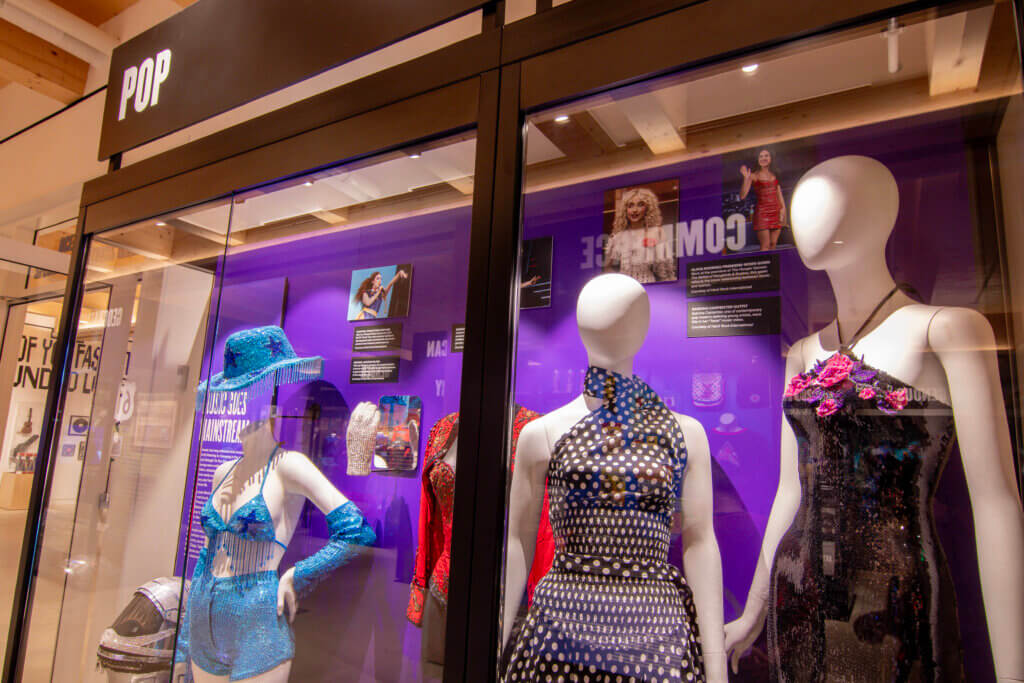
The “Pop” case in our American Music Gallery, featuring artifacts and costumes from: Lady Gaga, Chappell Roan, Michael Jackson, Sabrina Carpenter, and Olivia Rodrigo (all courtesy of Hard Rock International).
The connection is especially striking in the case of Daisy Chain Fields. Rodrigo’s festival draws inspiration from earlier efforts to create space for women artists, but it also speaks to a much longer tradition of musicians using live performance not simply to entertain, but to build community, challenge assumptions, and create cultural change.
Bruce Springsteen has long been part of that tradition. Throughout his career, Springsteen has participated in concerts and events that served larger purposes, supporting causes ranging from family farmers and veterans to hunger relief and social justice. Like Monterey Pop, Woodstock, Farm Aid, Lilith Fair, and now Daisy Chain Fields, these gatherings demonstrate how music can bring people together around shared values as well as shared songs.
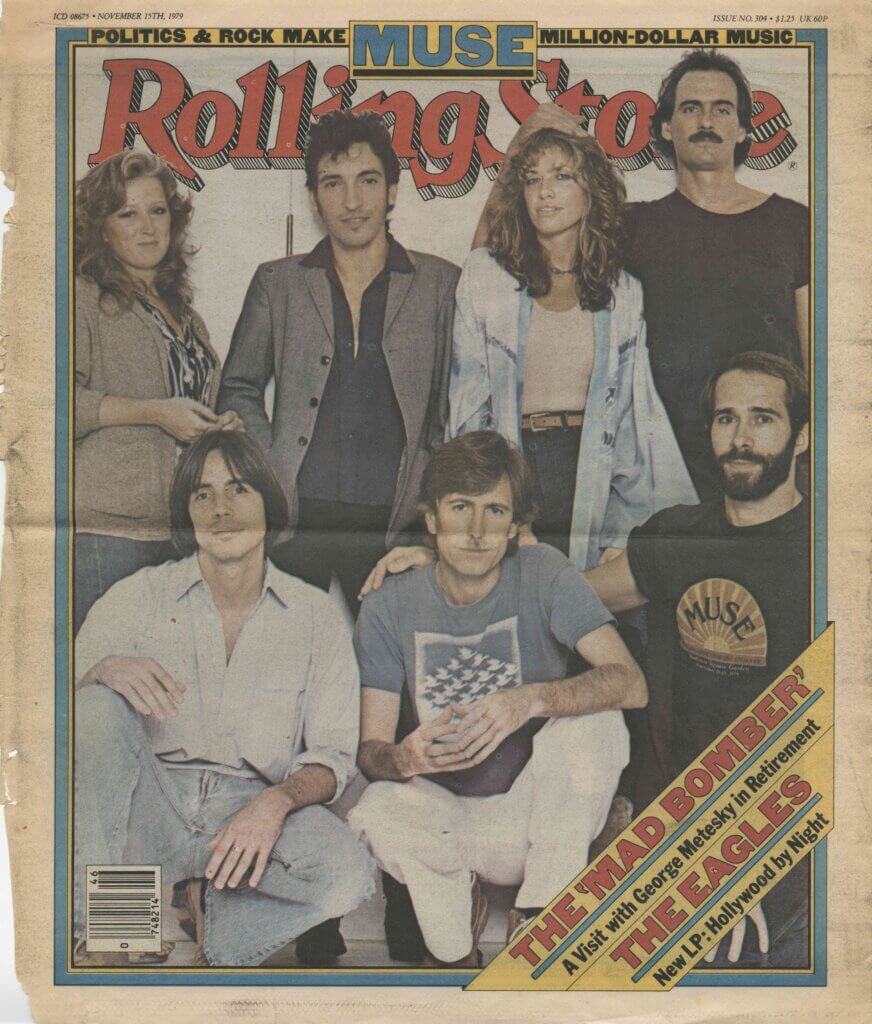
Rolling Stone cover celebrating MUSE (Musicians United for Safe Energy), the environmental activist collective co-founded by Jackson Browne, Bonnie Raitt, and Graham Nash. MUSE used music to raise awareness about environmental protection and sustainability and is covered in our “Chimes of Freedom” exhibit.
Museums often focus on the artifacts that remain after the amplifiers are packed away and the crowds go home. But the history of music festivals reminds us that some of the most important stories in American music are not just about records, costumes, or instruments. They are about communities—people gathering in fields, parks, fairgrounds, and stadiums to experience something larger than themselves.
From Monterey Pop’s celebration of a changing culture in 1967 to Daisy Chain Fields’ vision of empowerment and inclusion in 2026, music festivals have served as mirrors of American society—revealing not only what we listen to, but also what we value, what we hope for, and who we aspire to be. As you can see from the sneak previews of our exhibits afforded here—it’s all part of the conversations being had here at the Center.
Melissa Kozlowski
Director of Curatorial Affairs
Bruce Springsteen Center for American Music
Monmouth University
June 24, 2026