When visitors step into the Bruce Springsteen Center for American Music, they encounter galleries filled with extraordinary artifacts, immersive exhibits, and the sounds that have shaped our nation. What many don’t realize is that behind those public spaces are dedicated research facilities where scholars, students, educators, journalists, authors, musicians, and even the general public come together to explore the stories behind American music.
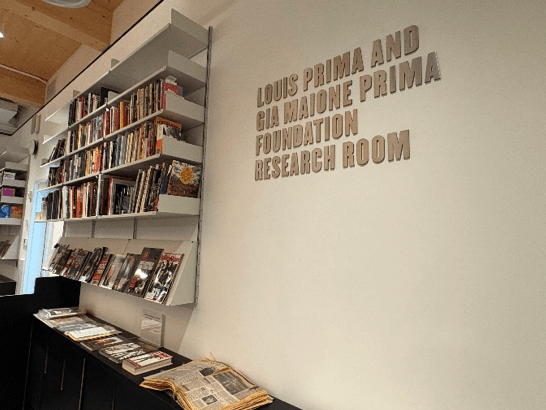
One of those spaces bears a particularly fitting name: the Louis Prima and Gia Maione Prima Foundation Research and Conference Room.
The room honors not only two remarkable performers, but also a Foundation dedicated to ensuring that the history of American music continues to be preserved, studied, and shared with future generations. Through its generous support, the Foundation has helped create a space where new discoveries about American music can take place every day.
Louis Prima: One of America’s Great Entertainers
Few performers embodied the joy and energy of American popular music quite like Louis Prima.
Born in New Orleans in 1910, Prima emerged from the city’s vibrant jazz scene before taking New York by storm in the 1930s. A gifted trumpeter, charismatic vocalist, songwriter, and band leader, he became one of the defining entertainers of the Swing Era while refusing to be confined to a single musical style. His career blended jazz, swing, rhythm and blues, Italian American traditions, comedy, and Las Vegas showmanship into something uniquely his own.
Prima wrote and/or popularized classics including Sing, Sing, Sing; Jump, Jive an’ Wail; Just a Gigolo/I Ain’t Got Nobody; and Buona Sera. Generations later, his recordings continue to influence musicians across genres.
Many younger audiences also know his unmistakable voice singing “I Wanna Be Like You” as King Louie in Disney’s The Jungle Book, introducing his exuberant musical style to millions of children.
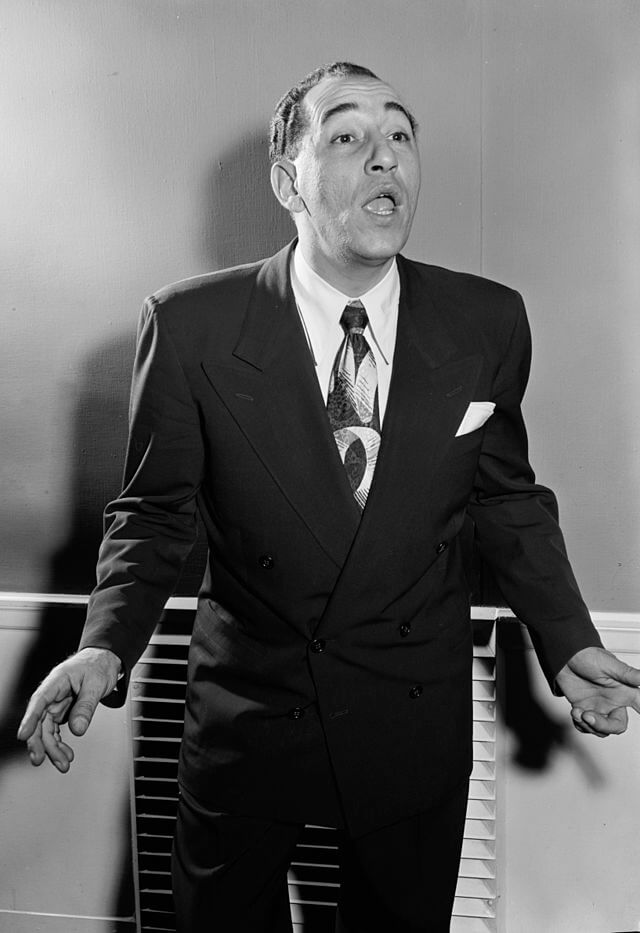
Louis Prima, 1947. Courtesy Wikimedia.
Gia Maione Prima: Performer, Artist, and Steward of a Legacy
Gia Maione Prima was much more than Louis Prima’s wife. A talented singer in her own right, the Jersey girl joined Prima’s touring act in the early 1960s, becoming his vocal partner during the later years of his career. Together they created one of the most recognizable stage acts in American entertainment, combining remarkable musicianship with humor and infectious energy.
Following Louis’s death in 1978, Gia devoted decades to preserving his artistic legacy while becoming an accomplished visual artist and generous philanthropist herself. She understood that preserving America’s musical heritage required more than safeguarding artifacts—it required supporting education, scholarship, and new generations of musicians and researchers.
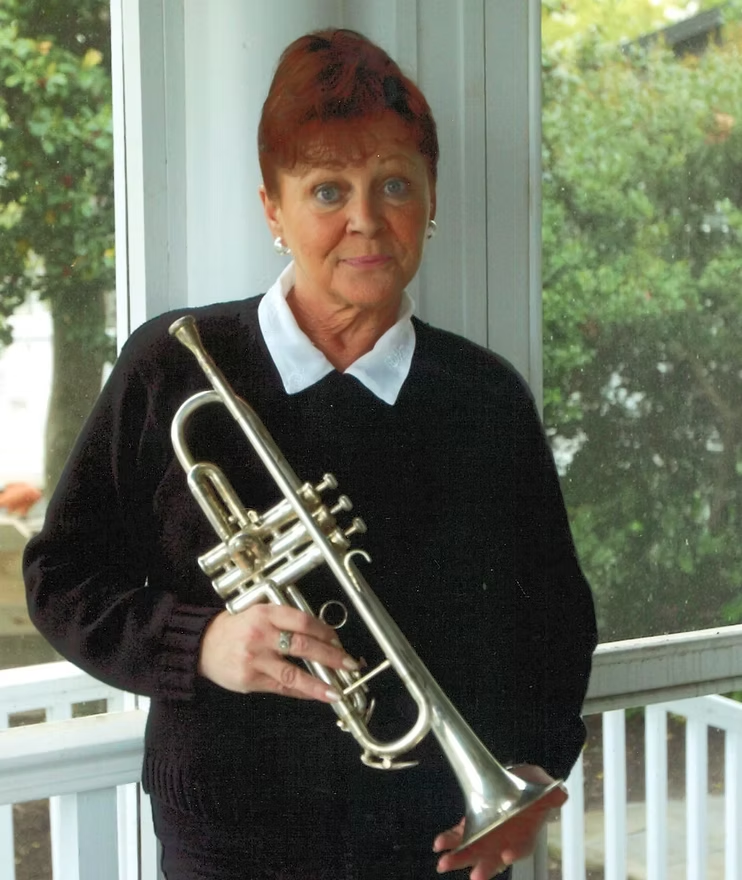
Gia Maione Prima, circa 2000.
Courtesy the Louis Prima and Gia Maione Prima Foundation.
Continuing Their Legacy
Established by Gia Maione Prima and her long-time counsel Anthony Sylvester before her death, the Louis Prima and Gia Maione Prima Foundation supports charitable, educational, artistic, and cultural organizations with a particular emphasis on American jazz, popular music, music education, and the fine arts. The Foundation has funded educational initiatives, fellowships, performances, and archival projects across the country, including partnerships with Tulane University, the Otis Redding Foundation, the American Jazz Museum, and now the Bruce Springsteen Center for American Music.
Its support of the Center reflects a shared belief that America’s musical story deserves to be preserved, studied, and made accessible to everyone—from lifelong scholars to curious students discovering these artists for the first time.
A Space Built for Discovery
The Louis Prima and Gia Maione Prima Foundation Research and Conference Room serves as a place where the general public can step into an archival setting and engage with a new selection of digitized materials from our collection each month. The rotating displays offer visitors an opportunity to explore documents, photographs, recordings, and other unique items that are not featured in the museum’s galleries, providing a deeper look at the stories behind American music. The space also serves as a hub for researchers, students, educators, and authors, supporting scholarship and fostering new discoveries that will continue to expand our understanding of America’s rich musical heritage.
Thanks to partners like the Louis Prima and Gia Maione Prima Foundation, the Center can continue fulfilling its mission to preserve, interpret, and celebrate the rich and diverse story of American music for generations to come.
I recently had the opportunity to chat with Tony Sylvester, steward of the Foundation, about its work. Here’s a lightly edited version of our conversation:
What inspired the establishment of the Foundation?
Gia had been classically trained as a vocalist. And from that, she ended up auditioning for an empty spot in the Louis Prima band once he and Keely [Smith] got divorced.
But Gia, having been classically trained herself, was worried about people putting less resources into the arts, whether it was the fine arts, whether it was music education. So, she just was very, very interested in seeing children have access to the arts, as she had.
We started the Foundation in June 2011, but it became more active after she passed in 2013.
Tell me again the story of how you met Gia.
Well, it was very simple. She moved back to Toms River to be with her mom, who was getting older. Her lawyer in New Orleans asked me to meet her, to represent her. I declined because I don’t do that kind of work, but she ended up coming to the office with an armful of records. We found a record player. We listened to records all afternoon. And then, you know, essentially—lawyers believe they can be versatile and we can figure things out.
So, then one thing led to another. We said, “okay, let’s give it a shot.”
How would you describe her personality?
She was very interesting. A very good businesswoman. She was at a young age with nothing but bills from Louis and a golf course in New Orleans where she had to learn how to mow the lawns and cut the greens. She never shook the New Jersey aspect of her, even when living in New Orleans or then moving to Florida. Which means, of course, that she said what was on her mind. She was very direct. You knew where you stood with her on any issue pretty quickly.
We have talked, of course, about Gia’s desire to support the arts, but can you talk a little more specifically about the Foundation’s primary goals and objectives?
Primarily, you can put it into a few buckets. One bucket certainly is music education. That money finds its way into summer camps and various programs. And then we also do what we can to put instruments in children’s hands. We take an annual trip to Havana, where we meet with the students, and we bring instruments and other things. We plan on doing that this year in Kingston, Jamaica instead. We’ll bring instruments and bring musicians. We also have a keen interest in community theaters, trying to get things into community theaters that might not otherwise be there. And then we also are involved in animal protection, with a few organizations in New Orleans. Much of our focus is in New Orleans. That’s where Louis was brought up. And there’s a great deal of need there. So, a lot of our efforts are in New Orleans.
What do you see as Louis’s legacy?
The songwriting and the entertainment. But I think probably what people would say is that he invented out of whole cloth the Las Vegas Lounge Act. There would have been no Rat Pack without Louis.
Tell me more about that.
What was happening is, he was put in a lounge right off the floor, and he would do five shows a night. First shows, midnight to last show, 5:15; he’d do five shows a night!
That’s a punishing pace!
Yeah, but that’s what they had to do. He had a remarkable ability to attract people to come play with them. Elvis would be a frequent visitor. Johnny Carson, a frequent visitor. And of course, Sinatra. And they saw the kind of fun he was having. And they wanted a part of it. And that’s what happened.
Now you’re mentioning these huge names, like Sinatra. Do you think Louis Prima is underappreciated today in comparison to some other artists?
Well, I think what happened was he died a little bit too young [in 1978 at 67 years of age]. My belief is if he had been still alive during, for example, the MTV era, he would have been the darling of MTV as an older musician. Because he really belongs in the Rock & Roll Hall of Fame as an early influence. Because if you listen to what he was doing in the 40s and 50s, it was very much an influence on rock & roll.
He had the whole New Orleans beat and rhythm. I’m certain he heard all the street musicians as he was growing up, including Louis Armstrong. But I think there has been a resurgence over the last 20 years of interest in his music. But people might not always know that he wrote it. For example, “Sunday Kind of Love.” It’s been a hit for many, many people. I’m pretty sure not too many people know that Louis Prima was an author of that song.
So interesting. Let’s go back to Gia for a moment. What role did Gia play in shaping and sustaining Louis’s career and then his legacy?
As far as his career is concerned, she was involved with singing with him for many years. When he passed, he was quite young. So, she was very instrumental in making sure the music stayed out there, either through licensing or making sure the record stayed out there.
That’s incredibly important because it would be so easy to slip into obscurity if you don’t have someone championing your work.
Yea; we’ve been lucky. Stanley Tucci put out Big Night, the movie, and that was all about Louis Prima coming to a restaurant at the shore, in order to save a failing restaurant. And it became quite an indie phenomenon, but almost at the same time, the Gap put out their Gap khakis commercial, which is a wonderful commercial. And it featured “Jump, Jive an’ Wail.” And then you had Brian Setzer have a hit with the song as well. So those sorts of things happened right around the same time.
And what happened then was Capitol Records put out the Louis Prima Collector’s Series, which is sort of a greatest hits volume. And it went gold. And so, the rest is sort of history because people started using the songs more for licensing. So, you started hearing it more, you know, Martin Scorsese, it’s like he wouldn’t have a movie without using a Prima song, like in Casino and such things. So, you started hearing him very frequently.
So of course, the Foundation generously supported the Bruce Springsteen Center for American Music. Why did you feel like that was a good fit? There’s no shortage of great causes that need your support.
Well, Gia was a Jersey Shore gal, and this is a Jersey Shore project. Right from the outset, it just seemed like it was the right fit not to have some involvement. I mean, this is really where she loved living. She loved the shore. A big hook for us, candidly, is that it’s not just a Bruce Springsteen museum. The fact that it’s a Center for American Music, and there’s going to be so many other programs going on, is sort of right up our alley.
You specifically supported a research space. Was that important, or special to you, in some way, that it be that space in particular?
You know, it struck me that I didn’t want the research piece to sort of be the stepchild, and I wanted to make sure it was on the same plane or plateau as the photographs or anything else. Because look, time’s going to pass, you know that. And you can see a photograph, and you see a spiral notebook. But how many times can you see it? But the intellectual or academic research will continue. I mean, who knows what the next generation’s perspective will be on what Bruce accomplished, what his impact was? And so, they have to have a place to do that research.
Is there anything you’d like to share about the Foundation, Louis, or Gia, that we haven’t covered?
The thing I’m impressed with every day is that Gia really was left in a bind. She was young, she had two young children, a husband in a coma and a lot of bills and a golf course! And she was quite astute in developing that into what has become a sizable Foundation. This just didn’t happen. Nobody handed her anything. It’s an incredible accomplishment on her part.
And that’s why I wanted to make sure we talked about it a little more because it’s not just a name on the wall. It’s this really inspirational story. And now we’ll be able to share a bit more with our guests! Thanks for your time, Tony.

Melissa Kozlowski
Director of Curatorial Affairs
Bruce Springsteen Center for American Music
Monmouth University
August 18, 2026