Taylor Swift fans received some exciting news today: the superstar will return to the stage at the Country Music Association (CMA) Awards on November 18, marking her first performance at the ceremony in 13 years!
Swift last performed at the CMA Awards in 2013, delivering an acoustic rendition of her song “Red” alongside Alison Krauss and Vince Gill. Her return is particularly meaningful given her beginnings in country music, long before she became one of the biggest pop stars in the world.
The announcement got us here at the Bruce Springsteen Center for American Music thinking about the history of music industry awards shows, the unforgettable performances they’ve given us, and the artists represented in our galleries who have taken home some of the industry’s highest honors.
And the Winner Is…
Today, awards shows are elaborate productions featuring red carpets, celebrity presenters, spectacular performances, and acceptance speeches that sometimes become as memorable as the music itself. But the tradition of recognizing musical achievement began on a much smaller scale.
The GRAMMY Awards, arguably the most prestigious honors in the recording industry, were first presented on May 4, 1959. Organized by the National Academy of Recording Arts and Sciences (now commonly known as the Recording Academy), the awards were established to recognize artistic and technical excellence in recorded music.
The name “GRAMMY” comes from the gramophone, an early sound reproduction device, and the familiar golden trophy takes its shape from that technology.
The first ceremony looked quite different from today’s extravaganza. Held simultaneously in California and New York, the event honored achievements in just 28 categories. Among the inaugural winners was Ella Fitzgerald, who received two awards, including Best Vocal Performance, Female. Fitzgerald is one of the many groundbreaking artists whose stories are represented in our galleries.
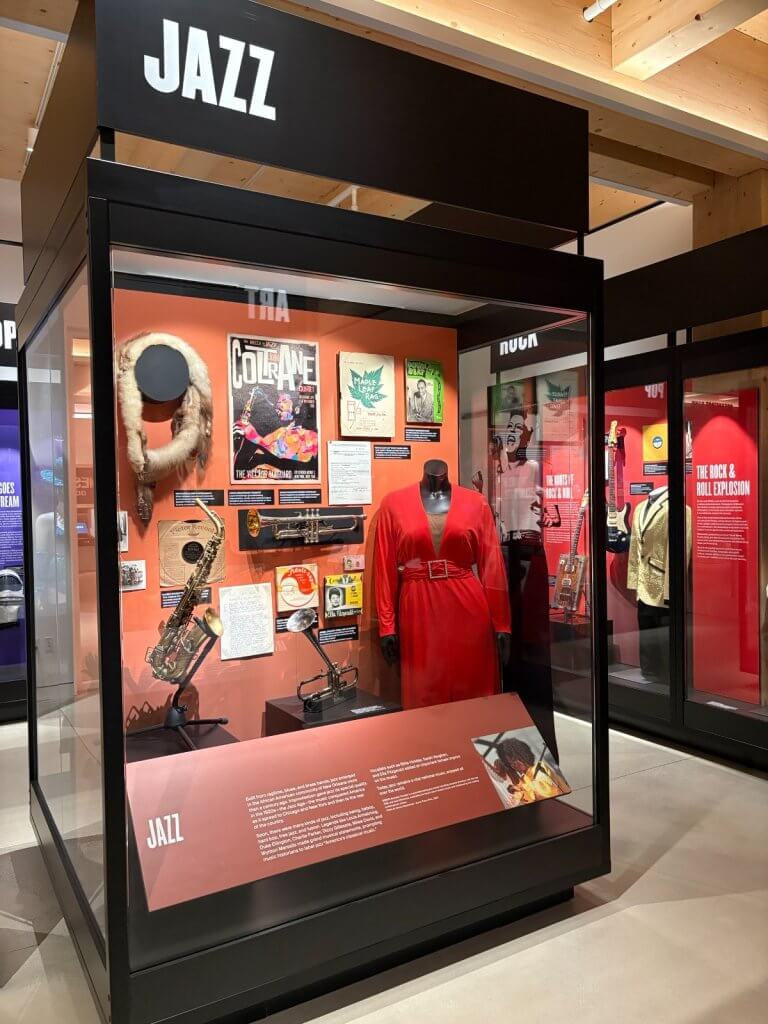
Can you spot the Ella Fitzgerald artifacts in our jazz exhibit? You’ll have to come visit to learn more!
Those first GRAMMY Awards were not televised at all. The second GRAMMY Awards were broadcast as a pre-recorded special. And the first live telecast occurred in 1971.
Other organizations soon developed their own awards traditions. The Country Music Association established its awards in 1967, with the ceremony first televised the following year. The American Music Awards debuted in 1974, distinguishing themselves from the GRAMMYs by emphasizing popularity and, eventually, fan voting. In 1984, MTV introduced its Video Music Awards, reflecting the growing importance of music videos as an art form and promotional medium.
And of course, we have our own awards tradition here at the Bruce Springsteen Center for American Music! Our annual American Music Honors celebrates artists whose creative contributions have shaped American music and influenced generations of musicians and fans. The ceremony brings together legendary performers for an evening of recognition, storytelling, and, naturally, some extraordinary live music. It’s one of the many ways we celebrate and preserve America’s rich musical heritage.
Each of these ceremonies tells us something about the music industry at a particular moment in time: what kinds of music were being celebrated, which artists were reaching new audiences, and how changing technology influenced the ways Americans experienced popular music.
Bruce Springsteen: From the GRAMMYs to the Oscars
We would be remiss if we didn’t talk about Bruce Springsteen here in this blog.
Over the course of his extraordinary career, Springsteen has received 20 GRAMMY Awards, recognizing everything from his songwriting and vocal performances to his contributions to rock music.
His first GRAMMY came in 1985, when “Dancing in the Dark” won Best Rock Vocal Performance, Male. That song, from his blockbuster Born in the U.S.A. album, helped introduce Springsteen to an even larger international audience.
One of his most significant awards came in 1995, when “Streets of Philadelphia,” written for the 1993 film Philadelphia, earned four GRAMMYs, including Song of the Year.
The song also earned Springsteen an Academy Award for Best Original Song at the 1994 Oscars, and a Golden Globe Award for Best Original Song. You can see one of Bruce’s GRAMMY Awards, his Oscar, and a Golden Globe on display on the second floor of the Center.
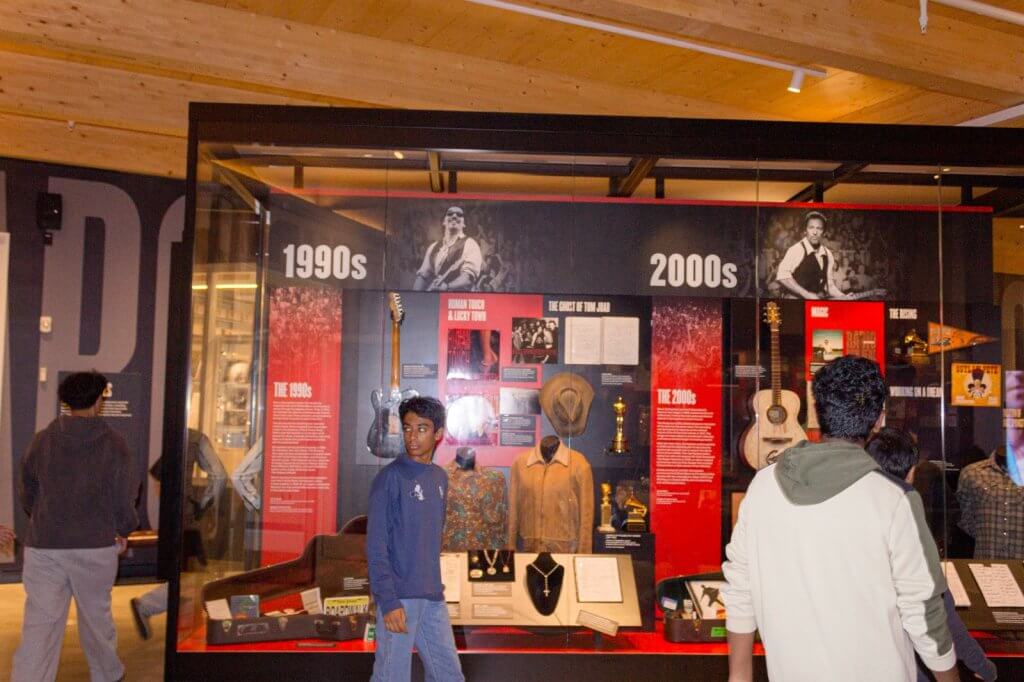
Some of Bruce’s awards on display.
These objects are more than trophies. They represent important moments in Springsteen’s artistic evolution and remind us that popular music can resonate far beyond the recording studio or concert stage.
“Streets of Philadelphia,” for example, helped bring wider attention to the experiences of people living with HIV/AIDS during a period when the disease was still surrounded by considerable fear and stigma. The song demonstrates how music can encourage empathy, challenge assumptions, and contribute to important national conversations.
Awards recognize artistic achievement, certainly. But they can also help us understand the larger cultural significance of a song.
When the Performances Become History
While awards shows are ostensibly about recognizing outstanding achievements, some of their most enduring moments have come not from the presentation of trophies, but from the performances themselves.
Consider a few examples of historic performances involving artists whose music and stories are represented here at the Center in our Jon Landau American Music Gallery:
Prince at the 1985 American Music Awards: Fresh off the phenomenal success of Purple Rain, Prince delivered an electrifying performance of the album’s title track at the American Music Awards. He also took home three awards that evening. His performance demonstrated the extraordinary combination of musical virtuosity, theatricality, and emotional intensity that made him one of the defining artists of his generation.
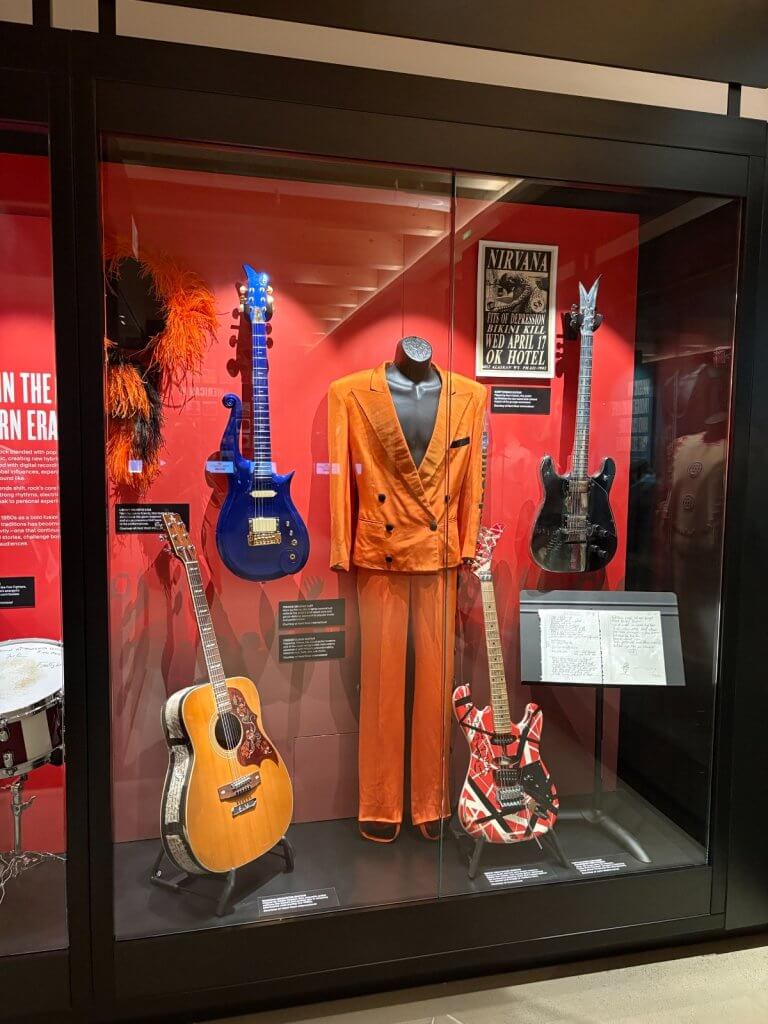
Can you spot the Prince artifacts in our rock exhibit? You’ll have to come visit to learn more!
Whitney Houston at the 1994 American Music Awards: Houston delivered a breathtaking medley of “I Loves You, Porgy,” “And I Am Telling You I’m Not Going,” and “I Have Nothing,” showcasing the extraordinary vocal range and emotional intensity that made her one of the most celebrated singers of her generation. She also made history that evening by winning eight American Music Awards, including the Award of Merit.
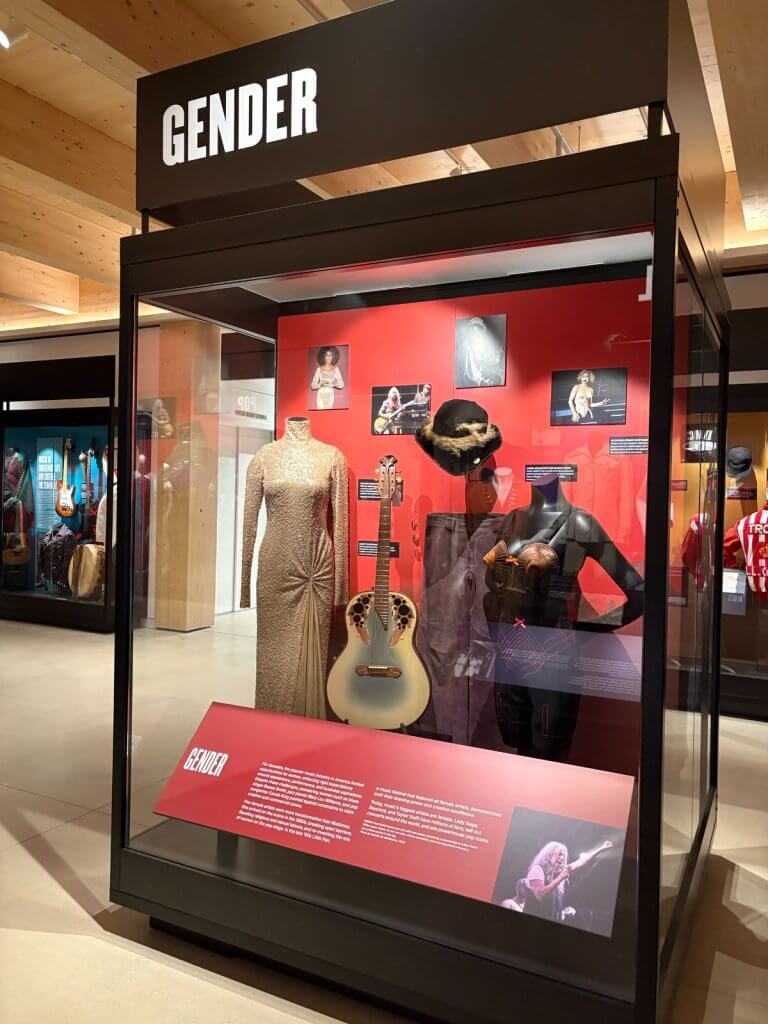
Can you guess which piece seen here belongs to Whitney?
Michael Jackson at the 1988 GRAMMY Awards: Jackson delivered a memorable performance that began with “The Way You Make Me Feel” before transitioning into the gospel-infused “Man in the Mirror,” accompanied by a choir. The performance demonstrated his ability to combine elaborate choreography and showmanship with music carrying a powerful social message.
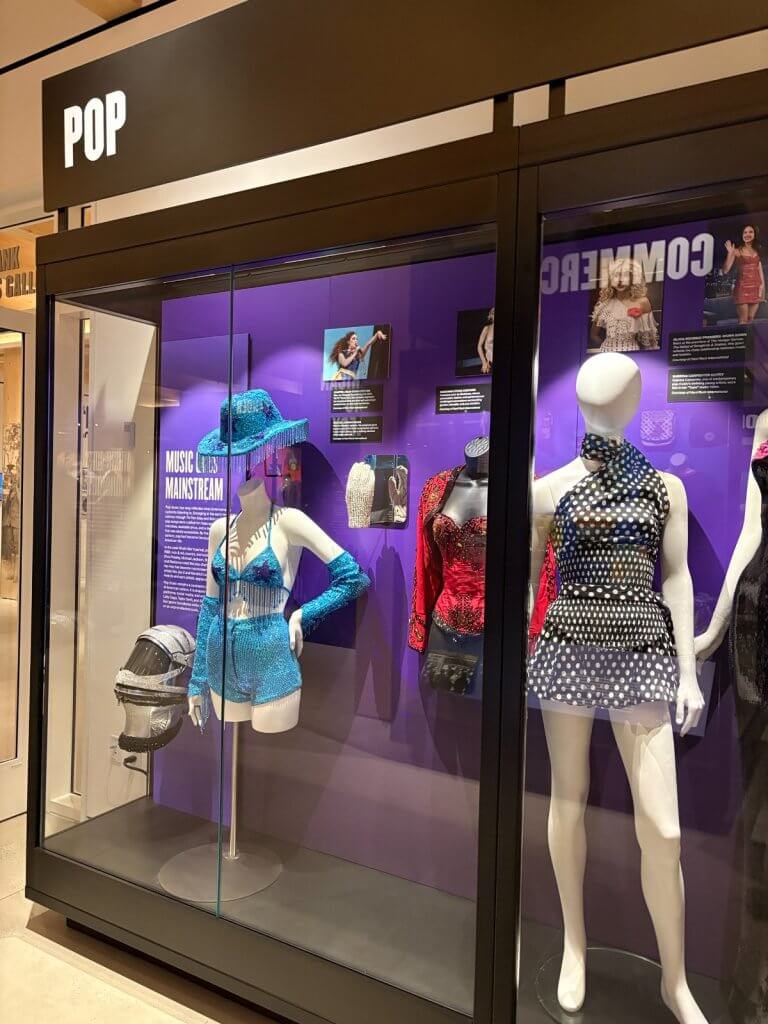
Michael Jackson’s glove is a favorite of school groups visiting the Center.
And there’s one more I have to mention: Madonna at the 1984 MTV Video Music Awards: At the very first VMAs, Madonna performed “Like a Virgin” in a wedding dress, creating one of the most talked-about moments in the show’s history. Her performance helped establish the VMAs as a place where artists could push creative boundaries and generate headlines well beyond the music industry. While not currently on display at the Center, we’ve featured Madonna’s “Like a Virgin” wedding dress, on loan from Hard Rock International, in our traveling “Music America” exhibit since 2024.
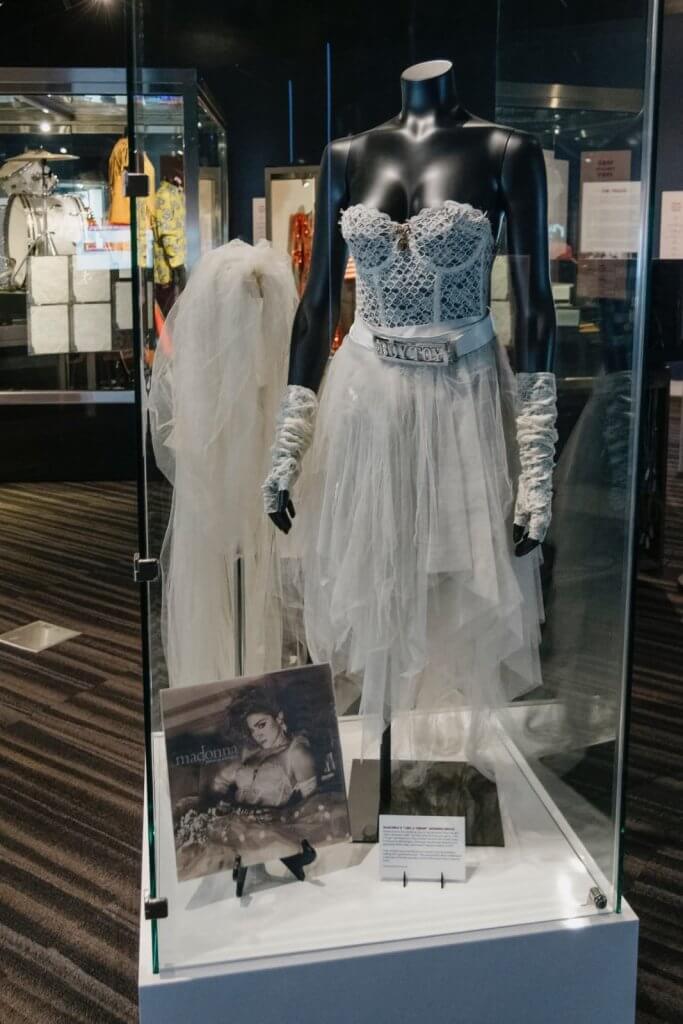
Madonna’s “Like A Virgin” dress on display with our “Music America” exhibit at the GRAMMY Museum in Mississippi.
And we could certainly keep going! Awards show stages have hosted unforgettable collaborations, tributes, reunions, and performances that introduced artists to entirely new generations of listeners.
More Than Just a Trophy
Awards shows have not been without controversy, because they are not always a meritocracy. Throughout their history, critics have questioned which artists and genres receive recognition, who gets to make those decisions, and whether commercial popularity always reflects artistic achievement.
Some of the most influential musicians in American history received relatively little awards recognition during their lifetimes. Others were celebrated only after their innovations had transformed popular music.
That is one reason we believe it is so important to tell the stories of American music through more than just chart positions, record sales, and awards.
At the Bruce Springsteen Center for American Music, we use artifacts, photographs, recordings, and personal stories to explore the people and events that shaped our musical heritage. The GRAMMY and Oscar on our second floor, for example, are certainly worth celebrating, but so are the countless other objects throughout our galleries that help illuminate the creative process, the experiences of musicians, and the extraordinary ways music connects us.
As Taylor Swift prepares to return to the CMA Awards stage, we’ll be watching along with millions of other music fans. Who knows? Perhaps her performance will become another memorable chapter in the history of music awards shows.
In the meantime, we invite you to visit the Center, explore the stories behind some of America’s most celebrated musicians, and see a few of those famous awards for yourself.
Melissa Kozlowski
Director of Curatorial Affairs
Bruce Springsteen Center for American Music
Monmouth University
November 13, 2026