For every iconic artifact on display at the Bruce Springsteen Center for American Music, there is often an equally remarkable story about the person who preserved it.
Our collections continue to grow thanks to individuals who understand that history is not only made by artists, but also by the listeners, collectors, scholars, and fans who recognize the importance of preserving it. One such individual is Gary Robinson, who recently donated his extensive Bruce Springsteen collection, including an extraordinary archive of rare bootleg recordings, reference guides, books, and related materials.
Growing up in difficult circumstances, Gary discovered Bruce Springsteen’s music as a teenager. When he first heard The Wild, the Innocent & the E Street Shuffle, he found something he had never experienced before: an artist who seemed able to give voice to emotions and experiences he had never been able to express himself. From that moment forward, Springsteen’s music became a lifelong companion.
Over the decades, that admiration evolved into a passion for preservation. Long before streaming services and online databases made recordings readily accessible, collectors played a vital role in documenting concerts, preserving performances, and sharing information with fellow fans around the world. His collection reflects decades of careful searching, cataloging, and scholarship, encompassing not only recordings themselves but the guides, indexes, and documentation that helped fans understand and organize this remarkable body of material.
We are deeply grateful that this extraordinary collection will become part of the Center’s holdings, where it will help support future research into Springsteen’s career, recording history, fan culture, and the broader story of how audiences help preserve American music.
As we’ve learned repeatedly while preparing the Center’s collections, preserving history is never the work of one person alone. It is made possible by communities of people who recognize that today’s personal treasures become tomorrow’s historical record.
Let’s hear from Gary in his own words:
Can you tell us a little more about your earliest memories of discovering Bruce Springsteen music?
The first song I heard by Bruce was “Blinded by the Light,” and I was fascinated by the lyrics. So many lines of words that made me think; what does he mean by that? “Madman drummers, bummers, and Indians in the summer, with a teenage diplomat,” for example. I experienced many madmen in the orphanage that treated me badly, many of my days at the home I considered bummers, and summers were the worst times because there were no school friends to talk to, just the crazy older orphan kids. I thought all the girls in high school who tried to fix things between young boyfriends and girlfriends were teenage diplomats. Of course, Bruce’s madman drummer was Vini Lopez, the Indians were his little league baseball team, and I guess his teenage diplomat was an early girlfriend.
You describe hearing The Wild, the Innocent & the E Street Shuffle as a life-changing experience. What was it about that album that resonated so deeply with you?
As mentioned above, I recall hearing “Blinded by the Light” on the radio in late 1973 or early 1974, the year I graduated from high school. I recall looking for the Greetings album in some of the local record stores but was unable to find it or perhaps couldn’t afford it at the time. In August/September of 1974, I was settling into college, and I remember a guy saying he was going to the record store off campus. I asked if he could pick up a copy of that new Springsteen record for me; the one with “Blinded by the Light” on it. When he came back, he said they didn’t have the album I wanted but there was another Springsteen album in the rack, so he bought me that one. I was a little bit disappointed, but that ended after the first time I played it. The Wild, the Innocent, & the E Street Shuffle album blew my mind. As a kid, I grew up in an orphanage and spent a lot of time listening to music on my own. Much like Bruce, I was extremely introverted and never felt like I fit in anywhere. Back then, I would play a song repeatedly, picking up and dropping the needle in the same spot over and over again so that I could learn the lyrics. So, I did that and found that the lyrics were relevant to what was going on in my mind mentally and emotionally at the time.
But it wasn’t just the lyrics. Now, it was Bruce’s fascinating storytelling abilities and the cinematic, almost operatic music that I could not get enough of. I loved that Bruce had experienced the same emotions, thoughts, questions, and answers about living that I was going through at the time. Bruce is seven years older than I am, but what he had experienced when he was my age, and converted into songs, gave voice to what I could not independently describe. To this day, in many of my relationships, I provide songs to my loved ones that verbally express the feelings I cannot describe on my own. I think this started when I was younger and didn’t know how to talk to people. I went to the movies a lot and particularly loved the Elvis movies. I saw how easy it was for him to talk to girls, and he did it through song.
What inspired you to begin collecting Bruce Springsteen recordings and memorabilia rather than simply listening to the music?
Two things really. The first was that the song “Born to Run” was released before the album was released and I was trying to find my own copy of it.
The second thing was the lawsuit. In the period between the release of Born to Run and Darkness on the Edge of Town, I was finding cassette tapes and vinyl that had bootlegged concert performances on them that included many other songs (some of which were to appear on Darkness and later albums). I could see how Bruce was trying out lyrics before settling on the final ones. I became interested in how Bruce creates his songs; how he moves things around, or how I’d hear things in later recordings. Certain boots (E Ticket, for example) were coming out that had early versions of songs that would appear on later recordings or parts of songs that were originally in one song would show up in different songs. There were also all the outtakes, which I had to have. And finally, sometimes Bruce would modify the album versions when performed live (“Prove It All Night ‘78” and “She’s The One/Mona” for example).
Your collection includes many rare bootleg recordings. Why do you think those recordings are historically important?
Certain recordings were very important because they track Bruce’s career, and many relate to what was going on in the world at the time he performed them. For example, the marvelous Vietnam veterans shows in Los Angeles.
Another example was the Bottom Line shows. Columbia was going to drop Bruce due to the poor sales of his first two albums, and he had to make his next album count. He did all those marvelous shows at the Bottom Line in New York in support of the Born to Run album which catapulted Bruce to the top of his industry. He was on the cover of TIME and Newsweek at the same time. The lawsuit period (detailed in the book Down Thunder Road) put an abrupt end to this period of fame. But, with the release of Born in the USA in the eighties, Bruce again ascended to the top of the music industry. Bootlegs from that tour document the tremendous performance abilities Bruce has, his ability to connect to the audience and each attendee on a personal level, his steerage of our emotions and moods via song selection, and the sheer number of songs and length of his concerts. These abilities will one day be hard to describe without such corroborating evidence as is available. Not many people have been to the top of their industries twice; but Bruce has.
Collecting before the internet required tremendous patience and dedication. What was it like searching for these items in those early years?
Before the internet, most of my collecting was done by word of mouth, attending record fairs, and finding record shops that stocked bootlegs. The vinyl products were expensive, and I had limited funds, so it was very slow, and I often had to discern between choices by reviewing bootleg catalogs. Cassettes were generally traded for free and the goal here was to find as early a generation of the tape as possible. Repeated copying created noise and distortions which made the tapes unlistenable except for us diehards. The advent of CDs reduced or eliminated the hiss and distortion and so I began to collect them. The digital format could be duplicated an infinite number of times with very little to no distortion.
Oftentimes, the artwork for the CDs was just a Xerox copy of the name of the product (like many of the vinyl boots), but as the major bootleg companies such as Crystal Cat and Great Dane got spun up, the artwork and verbal content often far exceeded that which major record companies like Columbia, Sony and Atlantic came up with. Details of a show such as the mood of the audience, the surprise changes to the setlist from night to night, the one-off songs played live rarely, the weather conditions during the event, and so on, really interested me. I also learned a lot about people in other countries to which I had never been, and how much they appreciated Bruce. For example, I learned that the Japanese people were extremely polite and rarely made noises during a concert, meaning clearer recordings of live shows and therefore better sounding CDs.
Was there one item that proved especially difficult to find or one acquisition you’re particularly proud of?
I remember that I could not find a copy of Crystal Cat Records 339-70, called “Sony and Tradewinds.” I needed it to complete my Springsteen Crystal Cat collection, and I had only ever seen one copy online. Over the years, I became friends with so many European boot collectors and sellers and many of them continue to go to record fairs even to this day. One of my guys told me he was going to a fair and asked what I needed for my collection. I told him I would give him $600.00 if he could find me a copy of this title and sure enough, he found it, sent it to me, and I kept my promise. The museum owns it now!
There were a few items, noted in the various bootleg catalogs I used for my collection, that I never was able to find. I continue looking for these items. If I ever locate them, I will donate them to the museum to help complete my collection. I think some of the most unique items I collected were the steel discs used to “stamp” and produce the bootleg 45s. Also, there was a bootleg of the Steel Mill Matrix show that came in various discs; regular, 14k gold, and picture discs as well as a boxed version in grey and a boxed version in purple. I always tried to collect every type of issuance, and I also had a vinyl copy that came in a tin silver LP-sized container that I have only seen one of in my 50 years of collecting. There might be others out there, but the museum now owns my copy. I doubt if another collector has all these items.
You also meticulously catalogued your collection. Why was documenting the material just as important to you as acquiring it?
Well, you must remember that I started the collection before the internet and eBay. I wanted to digitize everything I had because certain discs were subject to disc rot. I have included some of the “disc rot” CDs in my collection for historic reasons. Some of the CDs with disc rot were re-released but many were not so I wanted to save recordings before they rotted. Today, everything Bruce has put out and every show he has played can probably be purchased on Springsteen.net through Nugs in remastered quality. I never thought I would see the day that would happen, but here we are. In addition, I probably collected over 10,000 items of memorabilia, of which I have donated about 6,500 pieces to the museum. The rest will come later as I find additional items, and I am still working on the cataloging of my record company promos and other select CDs and other items. With so many items, I needed to know what I already had and what I needed so keeping a record of them was necessary. I did have the habit of acquiring more than one copy of an item so I could use them in trade with other collectors. I would also buy collectors entire collections in order to get a particular item I didn’t have, and those purchases resulted in duplicates as well.
Did your understanding of Bruce Springsteen’s music change as your collection grew over the years?
Absolutely. I learned so much about Bruce’s music and performances from the liner notes and artwork of the bootlegs and magazines I collected. I also learned a lot about other artists because Bruce played with or associated with so many other artists. John Eddie became, and still is, one of my favorite songwriters and I collected all his music. People like Gary U.S. Bonds, Darlene Love, Dropkick Murphys, the Clash, Joe Ely, Jesse Malin, Tracy Chapman, Robert Gordon, Graham Parker, Warren Zevon, Alejandro Escovedo, Woody Guthrie, and on and on. Bruce played on lots of tributes as well, which caused me to investigate those artists’ music.
Bruce not only increased my love for and acceptance of differing kinds of music, but he also got me interested in history. I remember reading David McCullough’s book, The Johnstown Flood because Bruce referred to it in “Highway Patrolman.” I remember re-reading The Grapes of Wrath because of “The Ghost of Tom Joad.” I purposely purchased a version that included articles that were written around the time when the book came out which reflected societal beliefs during the Great Depression period. I also read the Dale Maharidge book Journey to Nowhere because Bruce used it to inspire songs like “Youngstown” and “The New Timer.”
I also studied film in college and one of the directors I studied was John Ford. Around that time, I read that Jon Landau had discussed John Ford and his themes with Springsteen, and I feel like that knowledge may have contributed to some of the cinematic like music Springsteen writes. Bruce also talked about an author named Flannery O’Connor that affected his writing so naturally, I had to go and read all her short stories. Keep in mind that I grew up in an orphan home and was probably always looking for someone to help guide me in life, how to act, what to believe, and so on.
How do you hope researchers, students, and visitors will benefit from having access to your collection at the Center?
Put the headphones on, turn it up and enjoy! Hopefully listeners can feel the mastery Springsteen has over his audience and see how he did it repeatedly, night after night, performance after performance. I hope that listening to the CDs of the various shows and reading the insert verbiage that were written about the show, will provide an understanding of the effect that an individual can have, not only on a person, but on society itself, as a storyteller of history. It’s very hard, for example, to explain the effect that The Beatles had on society just by listening to their albums. The sound quality back in that time, especially in live concerts, was not up to today’s standards: i.e., Shea Stadium where the PA system was all they had and the audience’s inability to hear was the reason The Beatles stopped performing live concerts. How better to explain why a group performed so well that women went crazy, and mass fainting occurred?!
What made you decide that the Bruce Springsteen Center for American Music was the right permanent home for your life’s work?
I had learned a lot about Bruce’s early career and was aware of his connection to Monmouth University. I had at some point early on in my collection, come across a pamphlet called “New Jersey’s Monmouth County Music Heritage Map & Guide Volume 1: Musical Snapshot 1970-2003.” Having never been to the Asbury Park, Monmouth County area, I saved this for years and planned to use it as my guide when I finally did make the trip.
About five years ago, I relocated from the Baltimore/Washington, DC area to the Bethany Beach, DE area and I started going to a recovery group meeting where I made a lot of acquaintances and heard life histories of the members. One of those members mentioned that she had worked on the Rock & Roll Hall of Fame. After her talk, I told her that I had this big Springsteen collection that I wanted to donate to a Springsteen museum and asked her if she were aware of any possibilities. She asked me if I had ever heard of Bob Santelli, and I had. His books were part of my Springsteen library; I had read a lot of his writings and even had a bootleg with a voice recording of him talking to/about Bruce. She mentioned that she had worked with him at the Rock & Roll Hall of Fame and was aware that his next project was a Springsteen exhibit or museum at Monmouth University. I thought, “this woman is full of sh!!!.”
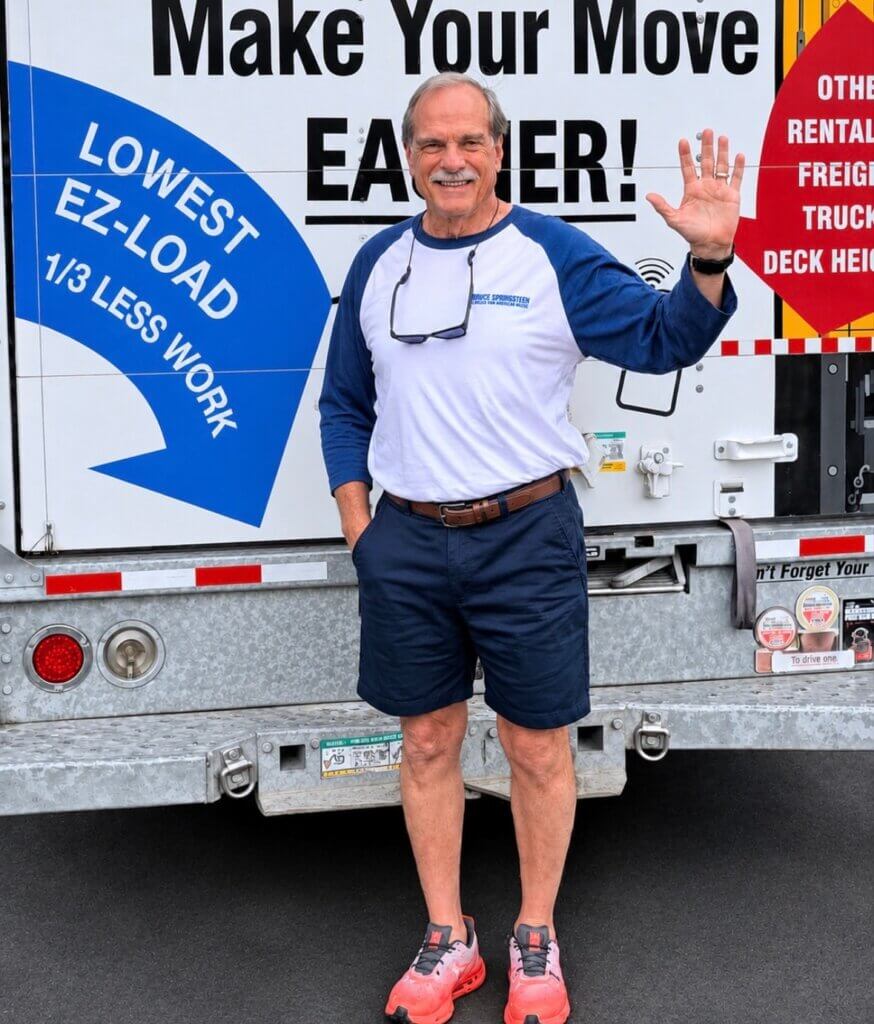
About 3 ½ years later, she told me that the museum was nearing completion and asked if I would like to meet Bob to discuss donating my collection. I said I would be honored to meet him. We met, he was interested, and I thought that the best place for my collection would be a New Jersey location. Bob and I kept in communication, and I drove my collection to the museum in June of 2026.
Bob was quite an interesting person, with a lot of musical knowledge and experience and he clearly loved and followed Bruce’s career almost as much as I had! Bob told me that Bruce liked the idea of having his archives remain in New Jersey but thought the museum should not be strictly dedicated to him; that it should encompass the whole of American music history and that he was only a part of American music. This seemed like a typical Springsteen comment as I have learned to understand him and his work.
Some of the previous questions herein discuss how Springsteen influenced my musical tastes, and introduced me to so many other types of music and artists. Of course, my collection includes items from other artists related to those influences. I believe that God had a part in getting my collection to this museum starting way back when I acquired the Monmouth County map and guide, all the way up to my introduction to Bob Santelli and my attendance at the museum ribbon cutting. Being there was quite an honor for me. By the way, when I delivered my collection, I used that guide to visit all the Monmouth County sites and I assure you, the presence of God was with me at each location. Seeing the sites I had read and heard about over the years was cathartic!
You’ve written that music helped you through difficult periods in your life. Looking back now, what role has Bruce Springsteen’s music played in shaping the person you’ve become?
I think I mentioned that I grew up in an extremely dysfunctional alcoholic home and was placed in an orphanage at age 10. So, much like Bruce, I never felt like I fit in anywhere and I had difficulty simply talking to people, and I lacked any sense of self-confidence. Those early feelings led me to an association with drugs and alcohol, a lifetime of therapy, and ultimately into the rooms of 12 step programs. Most recently, I have gone back to church where I have rediscovered a spirituality based on openness and acceptance to all people no matter what their beliefs as long as those beliefs are helpful and not harmful to others.
One way I learned to communicate more effectively with people was talking to folks about Bruce and his music. Especially at concerts where everyone is generally friendly and there for the music regardless of religious and political beliefs. In my youth, I had learned how to be prejudiced and intolerant of people who were different than me. It wasn’t until I went to college in 1974 that I learned all those ideas were crazy, unfair, and just plain wrong. (Note that that was also about the time I got very interested in this Springsteen guy.) I had always retained a conservative political outlook, primarily because I was from a poor family and did not want my earnings taken away in taxes. During the 2004 Get Out the Vote Tour, I secured tickets to the Philadelphia show, which included R.E.M. and John Fogerty. I had worn my Backstreets magazine T-Shirt sporting the “Clarence for President” graphics and while waiting in line, a reporter came up to me, said he liked the shirt, and after a brief discussion I told him I was a conservative. He asked me if there was anything I could hear at the concert that would change my mind and vote Democratic. I told the reporter something like, “If Bruce and I could sit down for an hour or so and discuss the issues, maybe I could be convinced. But that is never going to happen, and I am here just for the music not the politics.” The next day, the article ran, and my comment was quoted and attributed to Gary Robinson, a controller for a Washington, DC non-profit. I am happy to say, today, I have been voting Democratic since Obama and when I retired (and no longer worry about taxes on income I no longer make!), I even switched party affiliations.
As I have gotten older, it seems to me that Bruce’s music has given voice to the feelings I have had to deal with as major events occurred in my life. For example, my first marriage started experiencing problems right at the time when Tunnel of Love was issued. So many of the thoughts, fears, worries and apprehensions Bruce relates in that album, allowed me to better understand and express my own feelings.
For my second marriage (to Cathryn, a pastor), in July 2025, I wanted attendees to feel like they were part of the process in getting to that point in my life. Because of all the work I had done throughout my recovery and all the selfless efforts of many, many people in my life, I could think of nothing better to demonstrate this than Bruce’s song, “If I Should Fall Behind.” So, as the wedding started, the church monitors played a video version of the song from the 1999 Reunion Tour where each band member stepped up to the mic and sang a portion of the song. Much like Bruce was crediting his band members for their support and dedication to him, I wanted my wedding party to feel like they were part of my community and at the same time, to thank them for their assistance. It went over very well even though it was about seven minutes long.
As I began my recovery program and started to share my story, I almost always talk about a phrase or a lyric or even an entire song which helped me at a particular time. The song “Badlands,” for example, became a tale of my badlands (alcoholism, lost marriage, kids, house, etc.) and the words “I believe in the love that you gave me” refers to the folks I met in the 12 step program that helped me; “I believe in the faith that can save me,” refers to my ever-increasing dependence upon a spiritual way of life or God; and the words, “I believe in the hope and I pray that this will raise me, above these badlands,” so very clearly expresses the hope I had when I stopped drinking and drugging in the year 2000.
Another example is the song “Land of Hope and Dreams,” which I use as a story to tell a newcomer about the program; that they need to “Get on this train (the 12-step program),” we’ll take anyone with all their problems and idiosyncrasies, black, white, rich, poor, losers and winners, saints and sinners. After my 26 years of “rolling through fields where sunlight streams,” I can attest that “Dreams will not be thwarted” and “Faith will be rewarded.” It is never too late to change your life; it can happen, and it happened for me.
If you could speak to Bruce, what would you say?
The short answer is “Thanks.” Thanks so much for being the “Good Companion” I have needed on my side, not just for “this part of the ride,” but for my entire adult life. I have grown old with you and learned so much from you. Oh, and any chance you can get me good tickets and backstage passes to one of your shows?
Melissa Kozlowski
Director of Curatorial Affairs
Bruce Springsteen Center for American Music
Monmouth University
November 2, 2026