This Jazz Appreciation Month, we’re taking a look at some of the jazz artists, artifacts, and music you’ll encounter in our American music gallery when we open the Springsteen Center’s new home to the public on June 13.
Celebrated each April, Jazz Appreciation Month was established in 2001 by the Smithsonian Institution to recognize and celebrate the extraordinary heritage and history of jazz, as well as its enduring impact on culture around the world. The initiative highlights jazz as a uniquely American art form, rooted in African American communities and shaped by generations of musicians who transformed personal expression into a powerful, shared language.
Throughout the month, museums, schools, and cultural organizations host performances, educational programs, and exhibitions that explore jazz’s evolution from early innovators like Louis Armstrong and Duke Ellington to contemporary artists carrying the tradition forward. More than just a celebration of music, Jazz Appreciation Month invites us to reflect on jazz’s role in telling the story of America: its struggles, its creativity, and its constant reinvention.
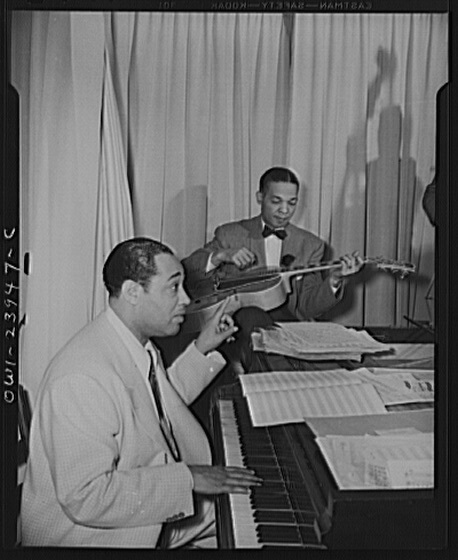
Duke Ellington, 1943. Courtesy Library of Congress.
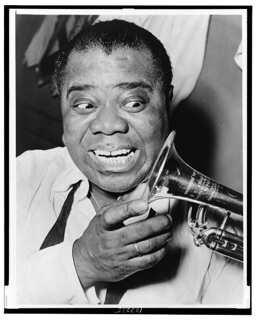
Louis Armstrong, 1953. Courtesy Library of Congress.
This is exactly what we aim to do, across genres, in our American Music gallery: use music as an accessible prism through which to explore all facets of life in America. Just as jazz tells stories of community, resilience, and innovation, so too do other genres illuminate the country’s diverse experiences. Hip-hop captures the voices of urban life and social activism; classical music reflects both the European roots and uniquely American compositions that shaped cultural identity; country music traces stories of rural life, migration, and regional traditions; rock and pop chronicle the shifts of youth culture, rebellion, and the mainstream; and folk and blues give us intimate snapshots of struggle, hope, and everyday life. By presenting these genres side by side, the gallery shows how music (whether emerging from a street corner, a concert hall, or a recording studio) mirrors the complexities, contradictions, and creativity that define American history.
But back to jazz.
Built from ragtime, blues, and brass bands, jazz first took shape in New Orleans over a century ago within the African American community. Its defining feature, improvisation, gave the music a vitality and spontaneity that set it apart. By the 1920s, the so-called Jazz Age, the music and its vibrant, freewheeling culture had captured the nation, spreading from New Orleans to Chicago, New York, and eventually across the country.
Over time, jazz diversified into a wide array of styles, including swing, bebop, hard bop, free jazz, and fusion. Legendary musicians such as Louis Armstrong, Duke Ellington, Charlie Parker, Dizzy Gillespie, Miles Davis, and Wynton Marsalis made enduring contributions that have led historians to call jazz “America’s classical music.” Vocalists like Billie Holiday, Sarah Vaughan, and Ella Fitzgerald left a lasting imprint on the genre, shaping its voice through unforgettable performances.
Artifacts on display in our jazz exhibit will include a contract signed by Sarah Vaughan, an Ella Fitzgerald dress and her cabaret card, a Dizzy Gillespie trumpet, Billie Holiday’s fur stole—and more! (I can’t give it all away here in this blog, can I?! We want you to come visit us!)
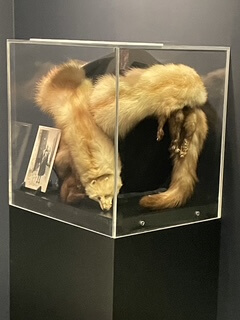
Billie Holiday’s fur on display in our “Music America” traveling exhibit in 2024.
Artifacts like these do more than showcase the glamour or fame of jazz legends, they act as tangible windows into history. Each item tells a story: the contracts, instruments, clothing, and personal objects reveal how musicians worked, lived, and navigated the social and cultural challenges of their time. By connecting visitors to the real, physical objects behind the music, these artifacts make history accessible and immediate, helping us understand the lives of the people who shaped jazz and, in turn, the broader story of America itself.
Listen
Our American music gallery will also feature a “song bar,” where visitors can sample curated music representing genres across history. Want to start listening from home? For a jazz introduction, we recommend, in no particular order:
“Ain’t Misbehavin’,” by Fats Waller (1929)
Andy Razaf wrote the lyrics to jazz staple “Ain’t Misbehavin’,” with music by Thomas “Fats” Waller and Harry Brooks. The song debuted at the premiere of the musical revue Connie’s Hot Chocolates in Harlem in 1929. First performed by Paul Bass and Margaret Simms, the Library of Congress estimates that more than 300 jazz and popular singers have recorded their own versions since – to include Fats Waller, Louis Armstrong, Jelly Roll Morton, and Nat King Cole. This Fats Waller version was recorded in the Camden, NJ studios of Victor Talking Machine Company in 1929.
“Black Bottom Stomp,” Jelly Roll Morton’s Red Hot Peppers (1926)
Jelly Roll Morton, born Ferdinand Joseph LaMothe in New Orleans around 1890, has been called jazz’s first arranger. He began his career as a piano player in a brothel, much to the chagrin of his family, and his nickname, “jelly roll” had ribald connotations. Eventually, the fast-living musician began writing his compositions down. “Black Bottom Stomp” especially highlights the complexity of Morton’s inspired works. Originally written in 1925 and called “Queen of Spades,” the song was recorded in Chicago by Morton and his Red Hot Peppers in 1926. Though lasting commercial success proved elusive, Jelly Roll Morton remains a titan in jazz history.
“Brilliant Corners,” by Thelonious Monk (1957)
“Brilliant Corners” was first recorded in 1956 for the album of the same name, released in 1957. It was an exceedingly difficult piece, which the band struggled to master in the recording studio. Ultimately, producer Orrin Keepnews knit elements of 25 different takes together to create the version that appeared on the record, and which you are hearing here. The song would later be recorded in a simplified form for Monk’s Blues in 1968. Brilliant Corners brought 39-year-old Thelonious Monk the recognition he’d sought for decades.
“Giant Steps,” by John Coltrane (1960)
“Giant Steps” was first recorded in 1959 for the album of the same name, released in 1960. It was the first LP Coltrane released that was comprised solely of his own compositions. Coltrane’s success as a solo artist was not guaranteed, with one critic of the album calling him a “harsh sounding player.” Still, the song, and the album more broadly, resonated with jazz enthusiasts. “Giant Steps” has been widely covered by other artists and is a staple in jazz music lessons around the globe to this day.
“Harlem Strut,” by James P. Johnson (1921)
Heavily influenced by a style of music and dance called the “ring shout,” which was inspired by African rituals and had been brought North during the Great Migration, James P. Johnson created a new style of piano playing that would eventually be dubbed “Harlem stride piano.” “Harlem Strut,” one of the earliest works of the Harlem Renaissance, was Johnson’s first piano solo on a 78rpm record, for the Black Swan label. Black Swan belonged to one of the first all-Black owned and operated record companies, the Pace Phonograph Corporation. Johnson and “Harlem Strut” became a model for a whole generation of pianists, like Fats Waller and Duke Ellington.
“How High the Moon,” by Les Paul and Mary Ford (1951)
“How High the Moon” was composed by Morgan Lewis with lyrics by Nancy Hamilton. It debuted on Broadway in 1940, and was first recorded by Benny Goodman and His Orchestra that same year. Multiple other versions by various artists followed. This version was recorded by Les Paul and his then wife Mary Ford in 1951. As the Library of Congress notes, “Paul’s use of multi-tracking to create layer upon layer of chorused sounds from the same instrument or vocalist, and the way it enabled just a few performers to produce the sound and feel of a large ensemble, would soon become the standard of the professional studio.”
“In the Mood,” by Glenn Miller and His Orchestra (1939)
Glenn Miller didn’t write his most famous hit, “In the Mood” – Black composer Joe Garland did. And the song drew heavily from earlier tunes like “Tar Paper Stomp,” “Hot and Anxious,” and “There’s Rhythm in Harlem,” in days when much music went uncopyrighted. Historians suspect Garland shopped “In the Mood” to a white bandleader knowing they would get more airtime on national radio – and it worked. The song was a massive hit. Miller’s career was cut short when his plane disappeared over the English channel while flying from England to France to do a show for servicemen in December 1944, and Garland essentially retired in the 1950s, but the beautiful music they created lives on in this instantly recognizable piece.
“One O’Clock Jump,” by Count Basie and His Orchestra (1937)
One O’Clock Jump became jazz pianist Count Basie’s biggest hit and signature song. Historians credit it with introducing “Kansas City-style” big band swing to the nation (which meant a much more improvisational style). The recording showcases some of the biggest players of the swing era, to include Basie himself, bassist Walter Page, and drummer Jonathan “Jo” Jones.
“Strange Fruit,” by Billie Holiday (1939)
Jewish American teacher Abel Meeropol wrote and composed “Strange Fruit” under the name Lewis Allan in 1939, drawing on a poem he wrote in 1937 titled “Bitter Fruit.” The song protests the lynching of African Americans and paints a stark and harrowing image of bodies hanging from trees like “strange fruit.” The song was performed live by several relatively unknown artists before being introduced to songstress Billie Holiday. Her recording label, Columbia, feared backlash if they released it, but gave Holiday permission to record and release it with Commodore Records.
“When the Saints Go Marching In,” by Louis Armstrong and His Orchestra (1938)
“When the Saints Go Marching In” originated as a Christian hymn, but its most famous rendition was recorded by jazz trumpeter and vocalist Louis Armstrong and His Orchestra in 1938. Though the song is beloved today, some at the time organized protests of it – with one reverend calling it a “sacrilegious desecration” of a Black spiritual. Still, the song stood the test of time and the joyful “When the Saints Go Marching In” is now synonymous with both Armstrong and with his hometown of New Orleans.
Read On
If we’re piqued your interest and you’re keen to learn more before you can visit us in-person, we recommend reading Jay Sweet’s Ray Brown: His Life and Music and Ricky Riccardi’s Stomp Off, Let’s Go: The Early Years of Louis Armstrong. You can catch our conversations with these authors here:
Jazz on E Street
While the E Street Band’s history is explored thoroughly on the second floor of our new Center and not in our American music gallery, jazz has had a subtle but enduring influence on the Band’s sound—particularly in its approach to improvisation, rhythm, and instrumental interplay. Musicians like Ernest “Boom” Carter and Clarence Clemons and Garry Tallent have often incorporated swing sensibilities reminiscent of jazz traditions, giving solos and rhythm lines a sense of spontaneity and nuance. The band’s horn arrangements, especially on tracks like “Tenth Avenue Freeze-Out” and “Jungleland,” show echoes of big band and brass traditions, where dynamic call-and-response patterns and layered textures create a rich, live energy. Jazz’s influence also emerges in live performances, such as extended saxophone solos or improvisational breakdowns in songs like “Rosalita (Come Out Tonight),” where the musicians play off one another in ways that mirror a jazz ensemble’s conversational style. Even in rock-driven songs, the E Street Band bends rhythms, syncopates riffs, and allows space for instrumental improvisation, blending structure and freedom to create their signature sound.
Closing Notes
At the Springsteen Center, our mission is to explore American music not just as entertainment, but as a lens through which we can understand culture, history, and society. Jazz—and all the genres represented in our gallery—offers stories of creativity, resilience, and the human experience. By engaging with the music, the instruments, the lyrics, and the artifacts, visitors can connect with the people and moments that shaped our nation. We want to help you experience these stories firsthand, and discover how American music continues to reflect, challenge, and inspire the world around us.
Melissa Ziobro
Director of Curatorial Affairs
Bruce Springsteen Center for American Music
Monmouth University
April 9, 2026