Today’s guest blogger, Louis Masur, is the Distinguished Professor of American Studies and History at Rutgers University, where he teaches a course titled “Springsteen’s American Vision.” The author of many books and essays, his latest work, From Presley to Springsteen: Ten Songs that Defined Rock and Roll and Transformed American Culture, will be published next year by Rutgers University Press.
Fifty years ago, Bruce Springsteen, accompanied by Stevie Van Zandt, jumped the stone wall at Graceland in the hope of meeting Elvis Presley. They arrived by cab after their April 29 show in Memphis, a show at which Eddie Floyd joined the band on Floyd’s hits “Raise Your Hand” and “Knock on Wood” (which included a rendition of “Yum, Yum, Yum, I Want Some”). It was the middle of the night, and after scaling the wall they scampered up the driveway. A guard stopped them. Springsteen asked if Elvis was home and tried to finagle his way in by saying he was a guitar player with a band and he had been on the cover of Time and Newsweek. It’s one of the few times he tried to use his rising renown in that way. The publicity had embarrassed him, but he was desperate to meet his hero. The guard said Elvis was in Lake Tahoe, and sent them away.
Springsteen’s impulse speaks to the significance of Elvis in his life and work. He was seven when he saw Elvis on the Ed Sullivan show. It made him want to play guitar, and it revealed something that spoke to him. “I couldn’t imagine anyone not wanting to be Elvis Presley,” Springsteen declares. He says, “Elvis is my religion. But for him I’d be selling encyclopedias right now.” His music “came in and took away so many people’s loneliness and [his] music . . .gave such a reason to live.”
In his SXSW speech in 2012, Springsteen elaborated on seeing Elvis on television as his “genesis moment.” “It was the evening,” he recalled, that “I realized a white man could make magic, that you did not have to be constrained by your upbringing, by the way you looked or by the social context that oppressed you. You could call upon your own powers of imagination and you could create a transformative self.”
Springsteen paid homage to Elvis by wearing an Elvis Presley fan club pin on the cover of Born to Run. Jimmy Iovine, at the time an engineer on the album, observed that “Elvis Presley was the big bang. He was the single most influential figure in the history of American culture. He changed the way we looked, thought, dressed, held a guitar. He didn’t invent rock ‘n’ roll, but he defined it in a way that everyone who followed owes him a debt . . . Elvis took the power of sexuality and rebellion and showed us how to be free.”
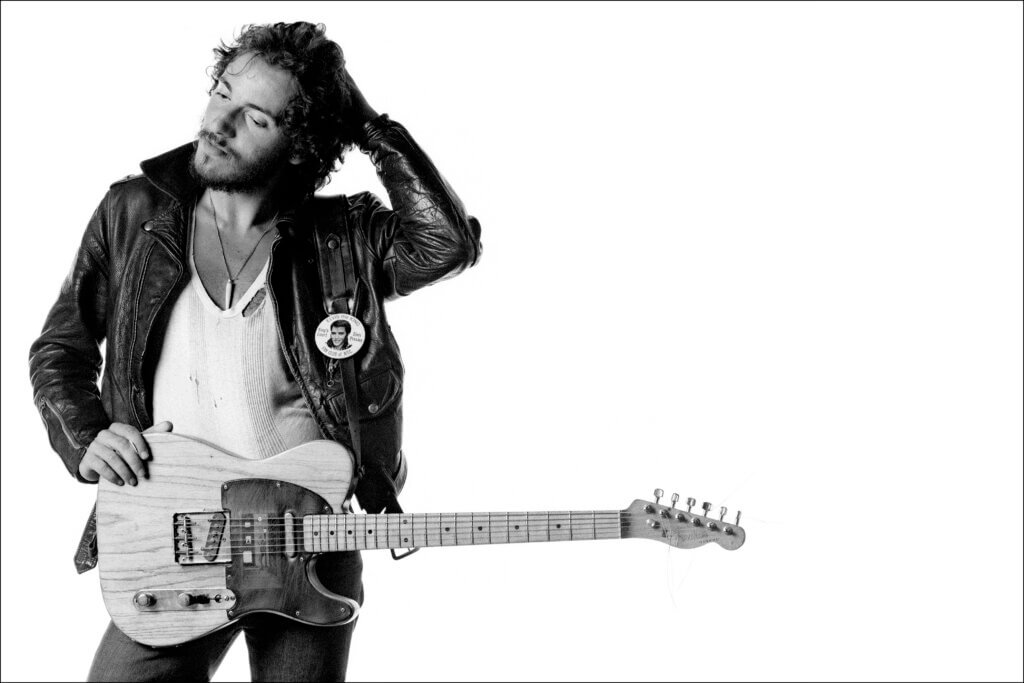
An outtake from the Born to Run album cover photo shoot, featuring the Elvis fan club pin. Courtesy Eric Meola.
On May 28, 1977, a year after his failed attempt at Graceland, Springsteen attended Elvis’ performance at the Spectrum in Philadelphia. By all accounts, it was not a good show. Elvis was unwell and his bloated appearance in a white jump suit must have come as a shock, especially for anyone with visions of the performer from twenty years earlier. Within days of the concert, Springsteen wrote “Fire” with Elvis in mind. If he sent a demo to him, it’s unlikely he heard it; Elvis died on August 16, 1977. Springsteen recorded the song during the Darkness sessions, but left it off the album. Robert Gordon first issued it (with Springsteen on piano) and The Pointer Sisters covered it in 1978. Their version rose to number 2 on the Billboard charts. (Springsteen says his favorite version is by Babyface with Des’ree).
When Springsteen heard the news of Presley’s death, he recalled, “it was like someone took a piece out of me.” He first wrote about Elvis’s passing in “Come On (Let’s Go Tonight),” also recorded during the Darkness sessions. Lyrics from that song migrated to others and, in 1981, Springsteen reworked Chuck Berry’s “Bye-Bye Johnny” into “Johnny Bye-Bye,” his lament over Presley’s death and his farewell to the man who left Memphis “with a guitar in his hand/ with a one-way ticket to the Promised land.” That same year, Springsteen reworked Presley’s “Follow That Dream” and started performing it live.
“Johnny Bye-Bye” ends “You didn’t have to die.” For Springsteen, Elvis’s life became a cautionary tale about the dangers of fame. Springsteen knew the pitfalls well and he even wrote about it with humor in the comedic “I’m Turning into Elvis,” a song performed only twice, the final time in Memphis in 1996. The song ends:
Well he came to me last night in a dream looking just like he did in ’57
He said ‘Son that guitar is a wonderful thing but it can be the living devils’ friend
On the other hand there’s sex-starved women, millions of dollars, and anything you want to do.
I’m turning into Elvis and there’s nothing I can do
Springsteen could joke about it because it wasn’t true. He had managed to navigate the dangers and distortions that could result from extraordinary fame and wealth. The guard at Graceland, he came to realize, did him a big favor. The rock ‘n’ roll dream was about the music and where it took you, not about the cult of personality. “That is a sidetrack, a dead-end street,” Springsteen says. Instead, “rock ‘n’ roll is about finding your place in the world, figuring out where you belong.”
It’s the music that matters, not the person, and no Presley song mattered more to Springsteen than “Hound Dog.” “When I heard it,” he recounts, “it just shot straight through to my brain. I realized, suddenly, that there was more to life than what I’d been living. I was then in pursuit of something, and there’d been a vision laid out before me. You were dealing with the pure thrust, the pure energy of the music itself. I was so very young, but it still hit me like a thunderbolt.”
“Trust the art, not the artist,” is an adage that Springsteen has embraced. It expresses a truth that first struck him the day he tried to meet Elvis and a security guard turned him away at the door.
Louis Masur for
The Bruce Springsteen Center for American Music
Monmouth University
April 22, 2026