Today in the Curatorial Corner, we’re featuring a guest blog by author and educator Caroline Madden.
Actor Timothée Chalamet may have recently dismissed opera and ballet as “outdated,”, but these art forms—along with musical theatre, plays, and more—are part of centuries-old storytelling traditions that we continue to enjoy and celebrate. These celebrations last year-round: every March during Theatre In Our Schools Month and World Theatre Day (March 27), on International Dance Day (April 29), National Playwriting Month (October), and Arts in Education Week (September).
For students, participating in theatre strengthens collaboration skills and self-confidence, helping them take risks, work together, and express themselves fully. For audiences, theatre nurtures emotional empathy and intellectual growth, allowing them to feel more deeply and contemplate the world in inventive and abstract ways.
Bruce Springsteen can be included in theatre observances as well, given his unique relationship with the performing arts. While we primarily regard him as a rock musician, his songs don’t just fill concert stages—they also find life in other theatrical forms, as some of the examples below demonstrate.
Anytown: Stories of America
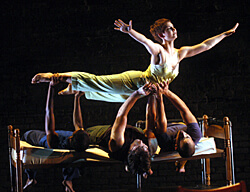
Photo credit: V. Paul Virtucio
In 2006, modern dancers Danial Shapiro and Joanie Smith created the production Anytown: Stories of America, a dance performance featuring the songs of Bruce Springsteen, Patti Scialfa, and Soozie Tyrell (Tyrell is Joanie Smith’s sister). According to The Source, the production toured for three years, visiting 60 cities across the United States. The Minnesota Daily reports that the show included songs such as “Human Touch” and “Glory Days,” alongside an acoustic rendition of “Born in the U.S.A.” and a rarely heard version of “Empty Sky” performed as a duet between Patti Scialfa and Bruce Springsteen.
Moving through the past and present, the modern dance follows three American families whose lives are deeply intertwined. In one standout number, “Countin’ On a Miracle,” a young man marches in uniform off to war. The athleticism and fluidity of the dancers’ bodies is stunning, elevating the ordinary emotions of Bruce’s characters into a primal force. You can see this in a preview clip from The Guthrie Theatre.
High Fidelity
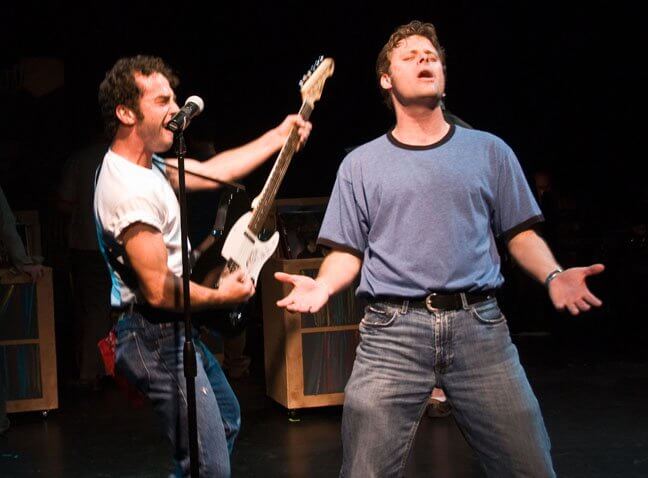
Photo credit: Michael C. Daft
Did you know that Bruce Springsteen was on Broadway before Springsteen on Broadway? Well…the parody version of him. Author Nick Hornby is a huge Springsteen fan, and he often includes Springsteen in his writing, including the novel High Fidelity, which was adapted into a 2000 film starring John Cusack.
In High Fidelity, Bruce makes a cameo appearance, offering advice to Cusack’s lovesick Rob. That advice became an entire song, “Goodbye and Good Luck,” in the short-lived Broadway musical adaptation, with a book by David Lindsay-Abaire and songs by Tom Kitt and Amanda Green. The show opened at the Imperial Theatre on December 7, 2006, and closed just ten days later. Despite its brief Broadway run, the show has since found a second life at regional theaters.
“Goodbye and Good Luck” is absolutely worth listening to, with hilarious lyrics full of Springsteen-style clichés that urge Rob to call his ex-girlfriends “like the ghosts that roam the main street of the steel town / where the plant’s been closed since Veteran’s Day.” Here is a performance from the New Line Theatre production.
The Promised Land
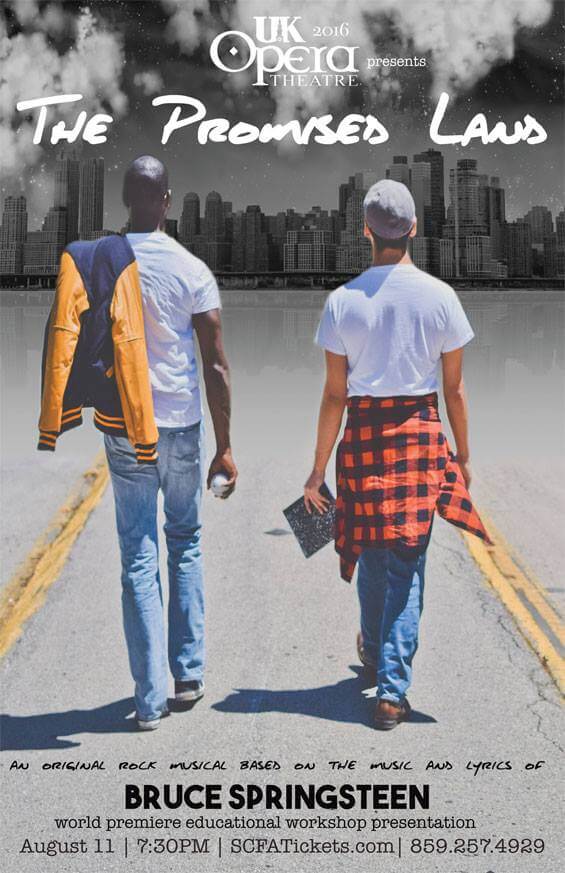
Photo credit: The University of Kentucky
Adam Max and Alex Wyatt’s The Promised Land is a “rock opera” in the vein of The Who’s Tommy and American Idiot, where existing songs from an artist are woven into a cohesive narrative. It was helmed purely for educational purposes, giving University of Kentucky students behind-the-scenes experience in crafting a workshop production.
The Promised Land “charts the coming-of-age journey of two blue-collar–bound high school graduates who dream of breaking the mold and finding a more meaningful purpose outside their small New Jersey town.” As The Lexington Herald-Leader reported, many of the songs were reworked, unexpectedly becoming female solos or sung by entire ensembles. While Springsteen has yet to receive the full jukebox musical treatment on Broadway, The Promised Land makes us wonder if the idea could actually be more exciting than cringey.
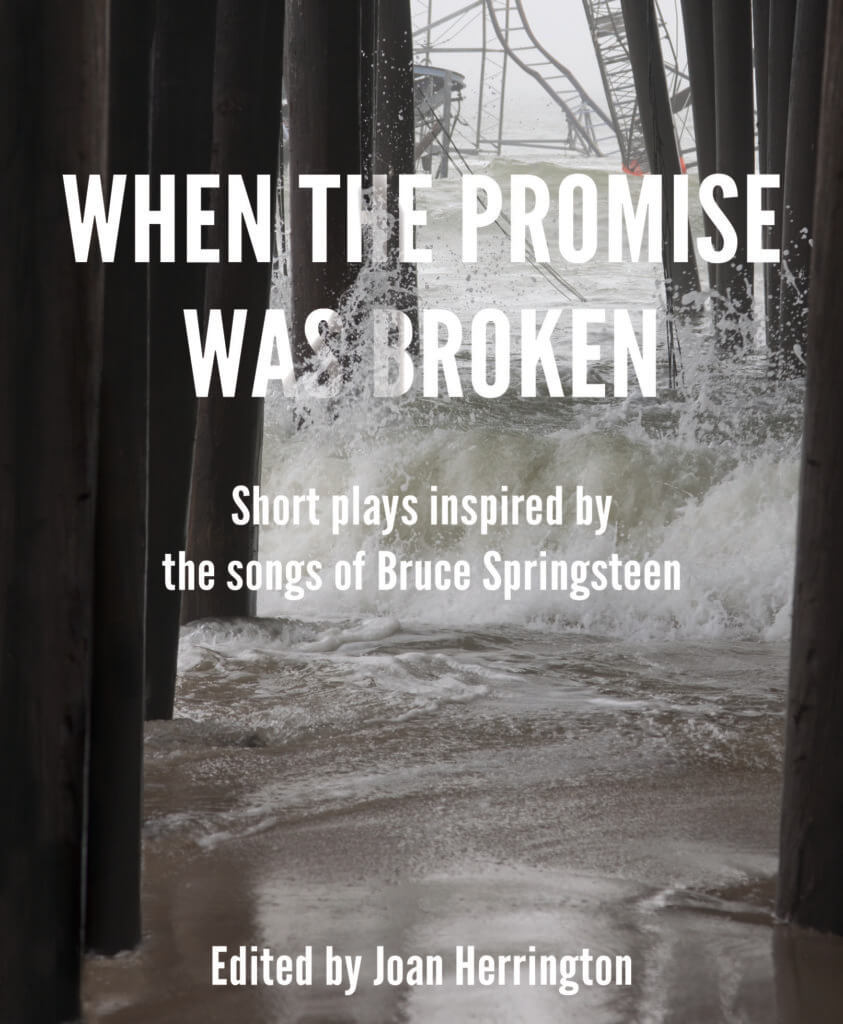
Photo Credit: Smith & Kraus
When the Promise Was Broken: Short Plays Inspired by the Songs of Bruce Springsteen
Despite lasting only a handful of minutes, Bruce Springsteen’s songs get so deep into what his characters are thinking and feeling that you want to know even more about them. When the Promise Was Broken: Short Plays Inspired by the Songs of Bruce Springsteen, edited by Western Michigan University theatre scholar Dr. Joan Herrington, delivers exactly that through the work of thirteen American playwrights. Published in 2018, the plays received a production in 2019 at Union College.
Many of the plays invent completely original stories and characters around songs such as “Cover Me,” “Drive All Night,” and “We Take Care of Our Own.” Tucker Rafferty draws from Nebraska in Glad for the Company, a one-man show starring “Charlie” Starkweather the night before he’s sent to the electric chair. Growin’ Up: Or I Was a Teenage Bruce Springsteen! by Steve Feffer is more imaginative, staging a Catholic-school–age Bruce in conversation with two different Elvises. The play was originally read at Glory Days: An International Bruce Springsteen Symposium in 2018. And then there’s Gregory S. Moss’s show with perhaps the greatest title in theatre history: A Semi-Autobiographical Response to Feelings of Sexual Inadequacy Prompted by Repeatedly Listening to Bruce Springsteen’s “I’m On Fire” for Four Hours Straight.
Springsteen on Broadway
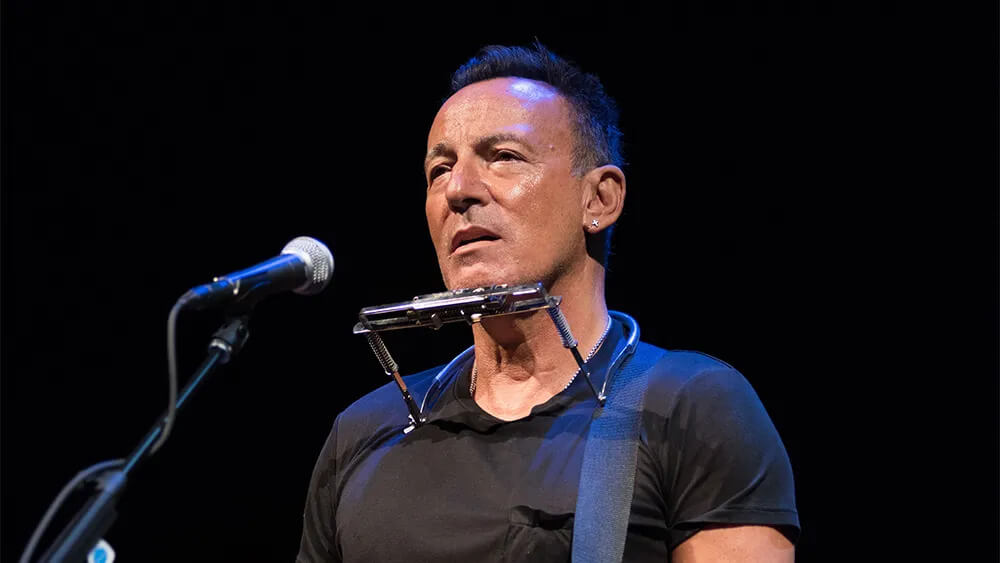
Photo credit: Rob DeMartin
Springsteen on Broadway (now streaming on Netflix) is what he describes in The New York Times as a “third entity,”—not quite a concert, not quite a one-man play. It weaves together monologue and song, bridging passages from his memoir Born to Run with stripped-down, haunting renditions of his most beloved songs in the intimate Walter Kerr Theatre (and post-COVID-19, The St. James Theatre). These emotionally raw performances trace both the arc of his life and the American historical backdrop that has shaped his art. Springsteen was awarded the Special Tony Award in 2018 for this unforgettable theatrical experience.
Bruce Springsteen’s songs are exceptionally well-told stories, and all theatre is built on storytelling. His detailed songs are intensely character-driven, rooted in given circumstances, and resonant with the universal struggles of the human condition. It’s easy to imagine Springsteen’s small-town characters—veterans, factory workers, runaways—standing shoulder to shoulder with the great figures of the American theatre canon: the shattered dreams of Arthur Miller’s Willy Loman in Death of a Salesman or the lonely instability of Tennessee Williams’ Blanche DuBois in A Streetcar Named Desire. On stage, he inhabits his song roles, along with the “Bruce Springsteen” persona, with all the vitality of the greatest thespian. Given this, it’s no wonder his music has captivated theatre artists and found a natural home on the Great White Way.
Caroline Madden is the author of Springsteen as Soundtrack: The Sound of the Boss in Film and Television and Virginity on Screen: The First Time in American Teen Films. Her booklet essay, “They’re Pulling Out of Here to Win: How Bruce Springsteen Steers John Sayles’ Coming-of-Age Journey,” appears on the Fun City Editions Blu-ray release of Baby It’s You. You can find more of her writing on www.carolinemaddenwriter.com. Caroline teaches film studies at Ocean County College.