
When Bruce Springsteen first introduced the song “American Land” during the Seeger Sessions tour in 2006, he was drawing on a much older immigrant tradition. Some point out that the song’s roots stretch back to a poem/song called “He Lies in the American Land,” written by an immigrant named Andrew Kovaly and recorded by Pete Seeger in 1958. But Bruce’s “American Land” also draws upon a much broader musical tradition: the countless immigrant ballads and work songs, so many now lost to time, that told the story of America from the perspective of those who arrived here with little but hope.
At first listen, “American Land” indeed sounds like a hopeful celebration. The music is rollicking and communal, built for stomping feet and raised glasses. Springsteen sings of a place where immigrants imagine that hard work will naturally bring prosperity and dignity. The spirit of the song echoes the exuberant folk traditions of Irish and immigrant music—songs meant to be sung together in crowded rooms, reminding listeners that they were not alone in their journey.
There’s diamonds in the sidewalk / The gutters lined in song
Dear I hear that beer flows through the faucets all night long
Springsteen sings of arriving immigrants believing that “there’s diamonds in the sidewalk” and “beer flows through the faucets all night long.” The lines evoke a long-standing legend told among newcomers to the United States in the nineteenth century: that opportunity was so abundant in America that wealth practically lay waiting in the streets.
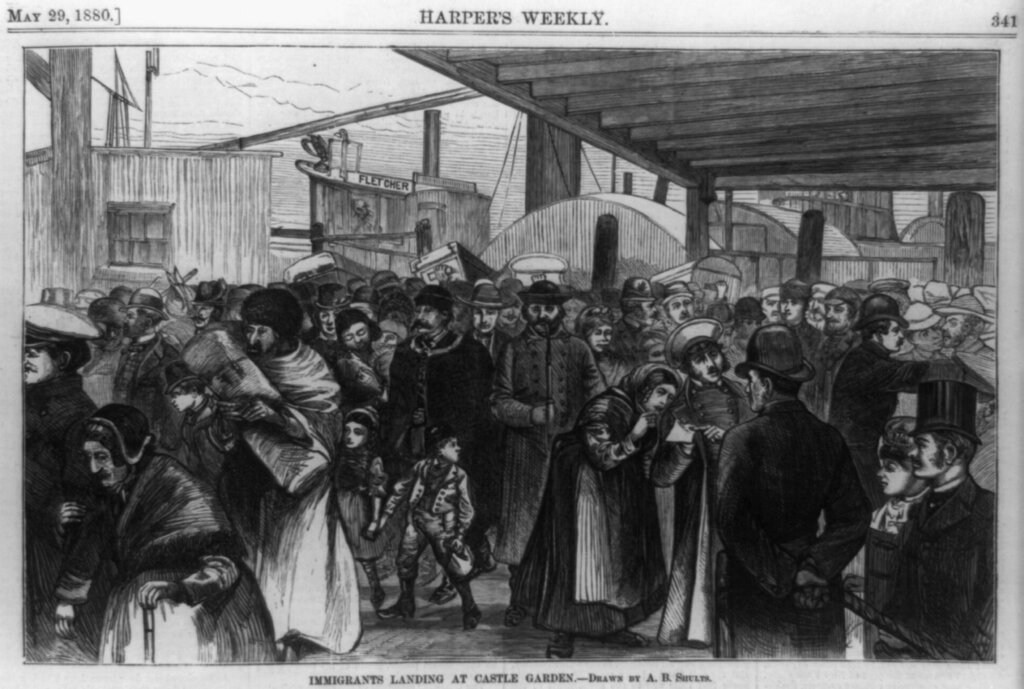
Caption reads, “Immigrants landing at Castle Garden / drawn by A.B. Shults,” 1880. Courtesy Library of Congress. Castle Garden, located within Battery Park at the southern end of Manhattan, served as America’s first immigration station before Ellis Island opened.
The reality for immigrants arriving in nineteenth and early twentieth century America, of course, was quite different. Many immigrants settled into a life of crowded tenements and dangerous, unregulated workplaces. And so even within the song’s joyous energy, Springsteen introduces darker notes, like:
They died building the railroads / They worked to bones and skin
With these lines, the song turns from celebration to remembrance. The promise of America drew millions of immigrants to its shores, including vast numbers from Ireland fleeing famine and poverty. Many found work in the most dangerous and grueling forms of labor available: digging canals, laying track for the expanding railroad system, and building the physical infrastructure of a rapidly industrializing nation. These were jobs that quite literally built the country—and that cost many workers their lives.
In a single line like this, Springsteen acknowledges that history. The railroads that connected the United States from coast to coast were monuments not only to progress but to sacrifice. Irish laborers were joined by workers from many other communities, including large numbers of Chinese immigrants in the American West, all contributing to the construction of the nation’s transportation networks. The myth of opportunity existed alongside the reality of exploitation and hardship.
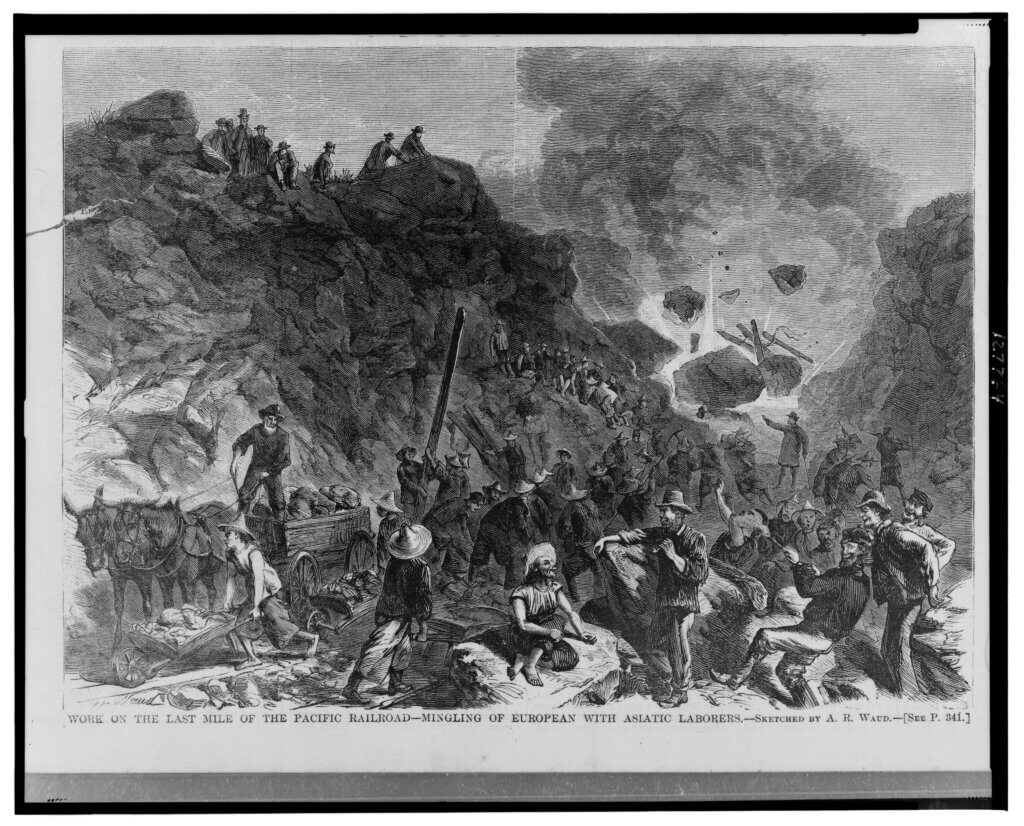
Caption reads: “Work on the last mile of the Pacific Railroad—Mingling of European with Asiatic laborers / sketched by A. R. Waud,” 1869. Courtesy Library of Congress.
The high-energy arrangement of “American Land,” with its pounding rhythm and sing-along chorus, can sometimes lead listeners to hear it purely as a celebratory anthem. That dynamic will sound familiar to longtime fans of Bruce Springsteen. Few songs illustrate the gap between sound and message more famously than “Born in the USA,” whose triumphant chorus helped obscure the darker story of a struggling Vietnam veteran at its center. In a similar way, the joyous musical energy of “American Land” risks overshadowing the deeper historical memory embedded in its lyrics.
That history resonates with Springsteen’s own background. The songwriter has often spoken about his Irish ancestry (his father’s family tracing its roots to Ireland), and about how the stories and sensibilities of immigrant communities shaped the world he grew up in. Those connections are visible not only in his music (he specifically name-checks his McNicholas and Zerilli roots in the song), but also in the places that shaped him. His hometown of Freehold, New Jersey maintains a “twin city” relationship with Rathangan, County Kildare, in Ireland, a symbolic reminder of the transatlantic ties that link many American communities to older immigrant histories.
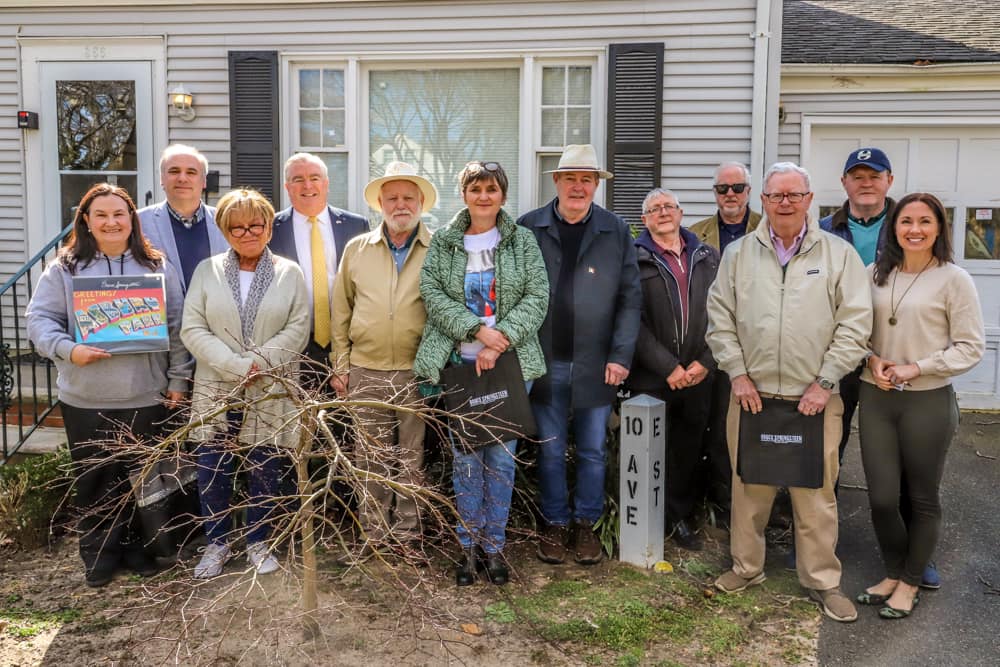
A contingent from Ireland visits the Center’s “Archives House,” our original home on campus, for a curator-led tour in March 2024.
Seen in that light, “American Land” feels both personal and universal. It draws on the experiences of Irish immigrants while speaking to a broader American story, one that includes countless groups who arrived seeking opportunity, contributed their labor, and reshaped the culture of the country in the process.
We made the steel that built the cities with our sweat and two hands
That perspective is also central to the work of the Bruce Springsteen Center for American Music. At the Center, music is not just entertainment; it is a lens through which we can better understand American history. Songs carry stories of migration, struggle, community, and hope that help illuminate the lived experiences behind historical events.
In “American Land,” Springsteen taps directly into that tradition. Beneath its joyful stomp and sing-along chorus lies a reminder that the American story has always been built by people arriving from elsewhere—people whose labor laid tracks, built cities, and helped shape the nation we know today.
The song invites us to celebrate that history. But it also asks us to remember the workers who, as Springsteen sings, “died building the railroads,” and the generations of immigrants whose dreams and sacrifices helped build America itself.
Melissa Ziobro
Director of Curatorial Affairs
Bruce Springsteen Center for American Music
Monmouth University
March 17, 2026