
At the 2009 Kennedy Center Honors, then President Barack Obama joked of honoree Bruce Springsteen, “I’m the president, but he’s The Boss.” This Presidents’ Day, we’re reflecting on the warm and authentic relationship between the singer-songwriter from New Jersey and the politician from Hawaii.
When Bruce and President Obama first met on the campaign trail in 2008, it wasn’t inevitable that the encounter would grow into one of the most visible and enduring artist/president relationships in modern American history. Rock stars have brushed shoulders with politicians for decades, but many of those encounters have been transactional. What distinguishes Springsteen and Obama is not just mutual admiration, but a genuinely shared language about America: its promises, its failures, and its unfinished work.
Springsteen had been wrestling with national identity long before Obama entered electoral politics. For decades, Bruce’s songs insisted on treating everyday, working-class lives as morally serious subjects. Even when Springsteen was misunderstood, and songs like “Born in the USA” misread as simple patriotic anthems rather than complicated reckonings, his goals remained consistent: to hold the American dream up to the light and ask who it truly served. By the time Obama emerged on the national stage, delivering the keynote address at the Democratic National Convention in 2004, Springsteen had already spent three decades chronicling the distance between American myth and American reality.
Obama, for his part, arrived as a political figure unusually attuned to narrative. His speeches (especially early on) were built not just around policy, but around stories: of family, migration, work, disappointment, and hope. Obama didn’t simply like Springsteen; he understood his music. He heard in Bruce’s songs an articulation of the same tensions he was trying to address politically: the dignity of labor, the ache of exclusion, the stubborn belief that the country could do better than it had.
Their synergies crystallized during Obama’s 2008 presidential campaign, when Springsteen began appearing at rallies and lending his music to Barack’s candidacy. This was not Springsteen’s first foray into electoral politics, but it was arguably his most wholehearted. Obama represented something Springsteen had been circling in his work since at least the Reagan era: the possibility of a patriotism that was neither naïve nor reactionary, but rooted in empathy and responsibility. When Springsteen performed at campaign events, he wasn’t seeking to elevate his own platform; he wasn’t just endorsing a candidate. He was endorsing a vision of America that aligned with his own lifelong artistic project.
What followed was less a celebrity friendship than a sustained conversation. Over the years, Springsteen and Obama would appear together at events, interview one another, and show great vulnerability in talking about things like fathers, doubt, faith, and failure. Their exchanges suggested an ease that went beyond ideology. Both men were shaped by complicated paternal relationships, by early experiences of not quite fitting in, and by a sense that public life required both performance and restraint. Those shared experiences created a shorthand that made their conversations feel unusually candid.
Culturally, their relationship arrived at a moment when Americans were renegotiating what leadership looked like. Obama’s presidency unfolded amid economic crisis, racial reckoning, and rising political polarization. Springsteen, for his part, increasingly occupied a role as a sort of national conscience, rather than just a rock star. Together, they modeled a form of masculine public life that prized reflection over bravado and vulnerability over domination. That, too, was political in its own way, even when neither man was explicitly talking policy.
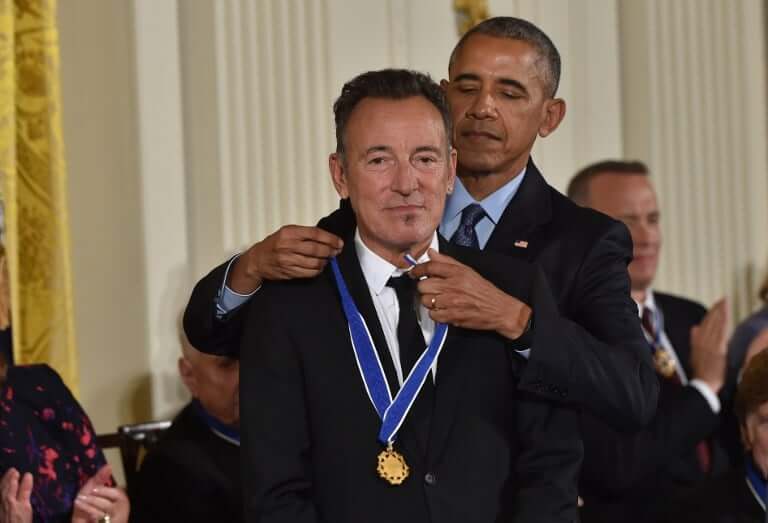
The durability of their bond became especially visible after Obama left office. Rather than receding into polite nostalgia, their dialogue deepened. Conversations between them returned repeatedly to the same questions: How do you hold onto hope without ignoring pain? How do you lead honestly in a country addicted to spectacle? What does it mean to love a nation that keeps breaking your heart? These are questions Springsteen has been asking in song since the beginning, and questions Obama grappled with in real time from the Oval Office.
If you’re not familiar with these conversations, check out the eight-episode 2021 podcast “Renegades: Born in the USA” and its companion book of the same name.
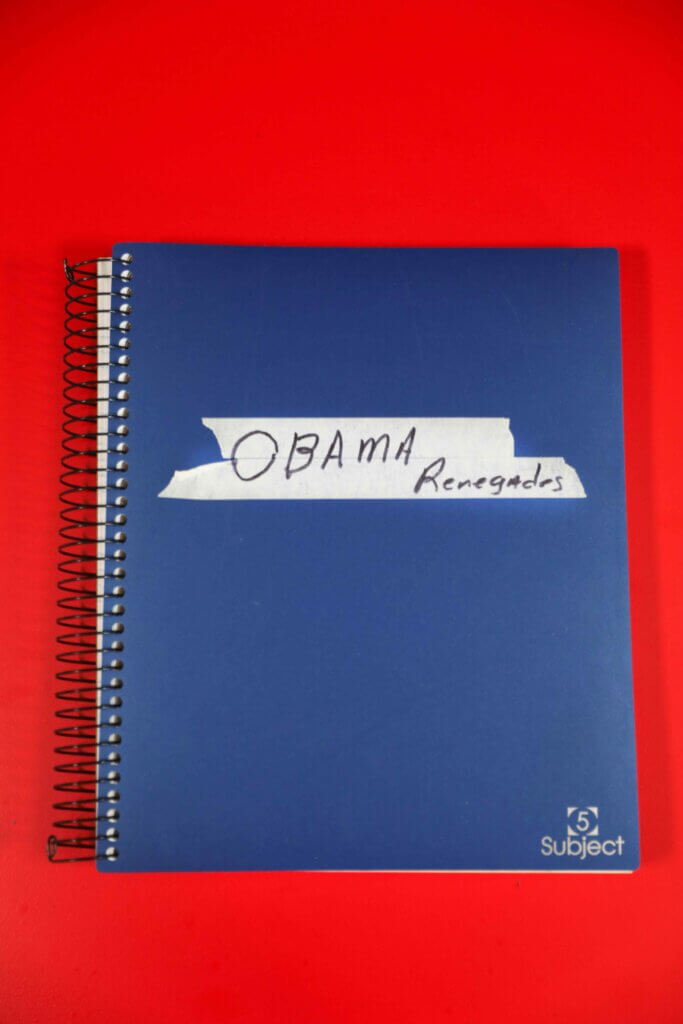
Bruce’s handwritten notes from the Renegades sessions. Photographed by Mark Krajnak for the Bruce Springsteen Center for American Music.
All this being said, Springsteen and Obama are less an odd pairing than they might seem at first glance. They are complementary figures in a long American tradition: the artist and the statesman, each translating the same anxieties and aspirations into different forms. Their relationship reminds us that politics and culture are not separate arenas, but overlapping ways of making sense of national life.
In the end, what makes their relationship compelling is not just society’s love of a good “bromance,” but the fact that Springsteen saw in Obama a listener who understood the stakes of his work, while Obama, in turn, saw in Springsteen a storyteller who had been preparing the ground long before his own rise. Together, they offered a vision of American identity that is skeptical but not cynical. It’s rooted in history, alert to injustice, and still willing, stubbornly, to believe in the promise of the American Dream for all.
Melissa Ziobro
Director of Curatorial Affairs
Bruce Springsteen Center for American Music
Monmouth University
February 16, 2026