
An earlier Women’s History Month blog saw us chatting about the Women of E Street. Today, I want to highlight several costumes from our traveling exhibit, Music America, that help tell the story of women in American music. Each represents not just an artist, but a larger moment in American history—moments when women helped reshape the sound, the business, and the cultural meaning of music, and gender, in the United States.
From early pioneers who broke into male-dominated industries to contemporary artists redefining genre and identity, these costumes aren’t just articles of clothing. They remind us that women have long been central to the soundtrack of American life.
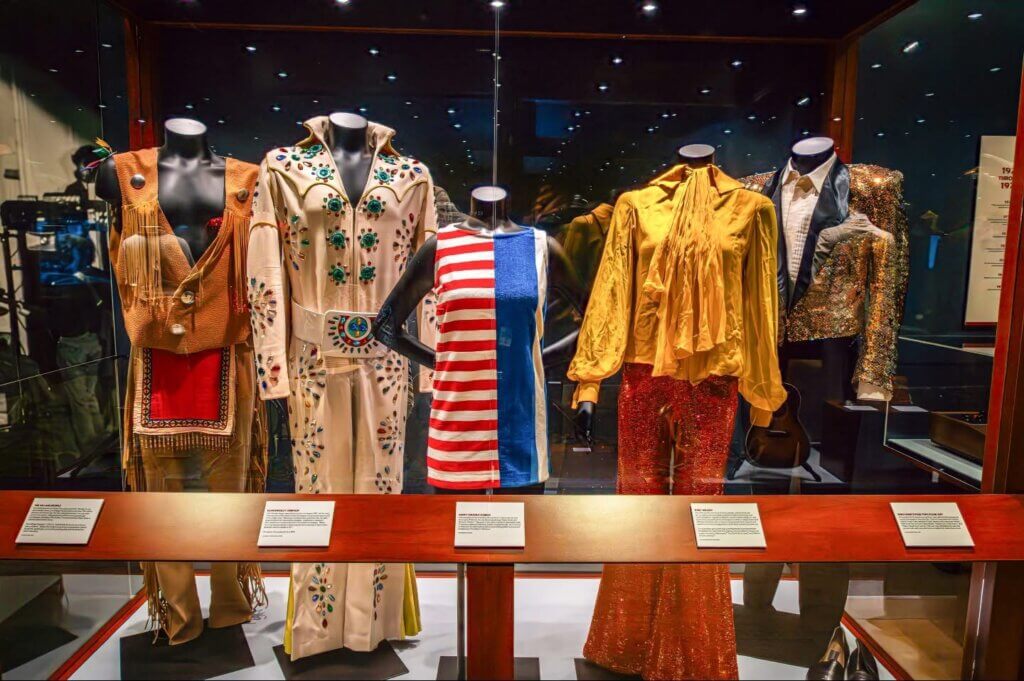
Music America at the George H. W. Bush Presidential Library and Museum in College Station, Texas
Nancy Sinatra’s American Flag-Themed Dress
The daughter of legendary entertainer Frank Sinatra, Nancy Sinatra emerged as a pop star in her own right during the 1960s. In early 1966 she scored a number one hit with “These Boots Are Made for Walkin’,” written and produced by Lee Hazlewood. With its distinctive bass line, confident lyrics, and bold attitude, the song quickly became one of the defining pop hits of the decade.
The recording also found an enthusiastic audience among American service members during the Vietnam War. Because of the song’s popularity with troops stationed overseas, Sinatra traveled to Vietnam in 1966 and again in 1967 to perform for American soldiers, entertaining service members and visiting those recovering in military hospitals.
Sinatra wore this dress while there. As both a stage costume and a piece of wartime history, it reflects the important role popular music—and the artists who performed it—played in boosting morale and maintaining a connection between home and the front lines.
Dress on loan from Nancy Sinatra.
Mary Wilson’s Glittering Stage Costume
Mary Wilson was a founding member of The Supremes, the groundbreaking 1960s Motown girl group that also included original members Diana Ross and Florence Ballard. Signed to Motown Records by label founder Berry Gordy, the trio became one of the most successful and influential vocal groups in American music history.
Under Gordy’s careful guidance, the Supremes cultivated an image of glamour, poise, and sophistication. Their coordinated gowns, elegant stage choreography, and polished etiquette were designed to present a vision of Black excellence that could appeal to mainstream audiences during a period of profound social change in the United States. This image complemented their smooth, tightly blended harmonies and helped the group cross racial boundaries at a time when the nation was deeply divided.
Throughout the mid-1960s, the Supremes dominated the pop charts, at times rivaling the success of The Beatles. The trio scored twelve number-one singles, including “Where Did Our Love Go,” “Baby Love,” and “You Can’t Hurry Love.” Their success helped define the “Motown Sound,” bringing soul-influenced pop music to a global audience and opening doors for countless Black artists who followed.
As a founding member and the longest-serving Supreme, Wilson remained with the group throughout its many lineup changes. Her career—and the enduring popularity of the Supremes—illustrates how women performers played a central role in shaping the sound, style, and cultural impact of American popular music during the 1960s.
Costume on loan from Mary Wilson Enterprises.
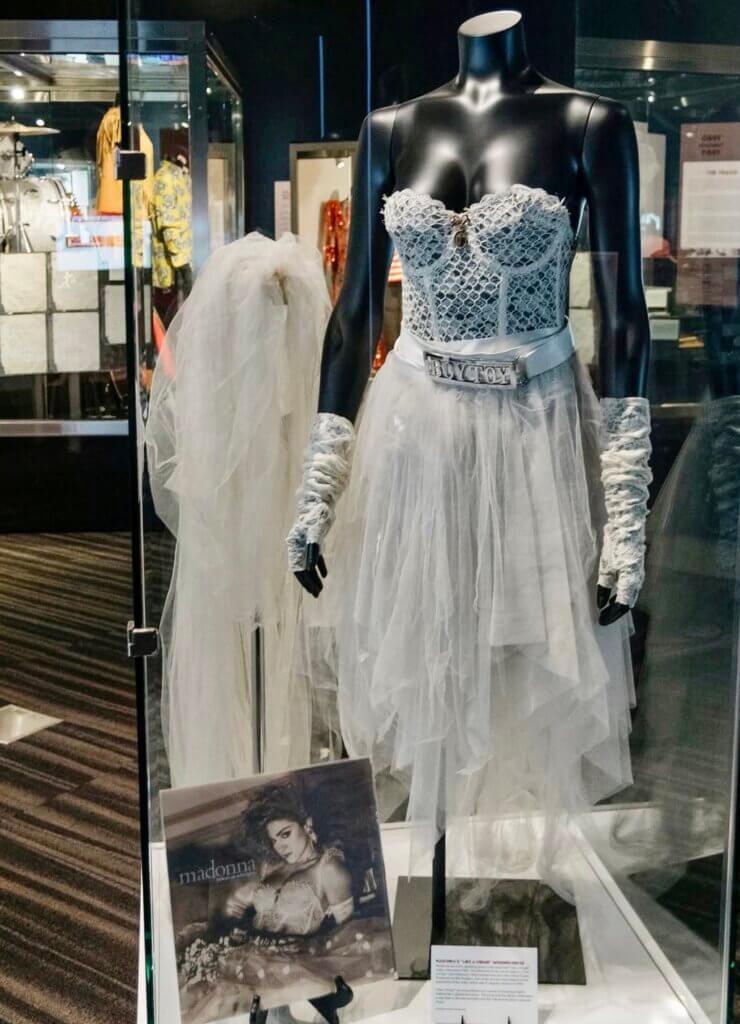
Music America at the GRAMMY Museum in Cleveland, Mississippi
Madonna’s “Like a Virgin” Wedding Dress
Madonna wore this wedding dress in the video for “Like a Virgin,” released in 1984. The title track of her second album, Like a Virgin, the song became Madonna’s first number one hit in the United States and marked a turning point in her career. Produced by Nile Rodgers, the track combined dance-floor energy with a playful and provocative lyric that quickly captured the public’s attention.
The song’s impact was amplified by its widely viewed music video, which was placed in heavy rotation on MTV during the early years of the network, when music videos were rapidly reshaping the way audiences experienced popular music. Filmed in Venice, Italy, the video paired romantic imagery with Madonna’s now-iconic bridal look, blending innocence and sensuality in a way that sparked conversation and controversy.
“Like a Virgin” propelled Madonna to international superstardom and established her as one of the defining pop artists of the 1980s. More broadly, the song and its imagery reflected a shifting cultural landscape in which women performers were increasingly asserting control over their public personas, challenging expectations about female sexuality, and redefining the role of women in popular music.
Dress on loan from Hard Rock International.
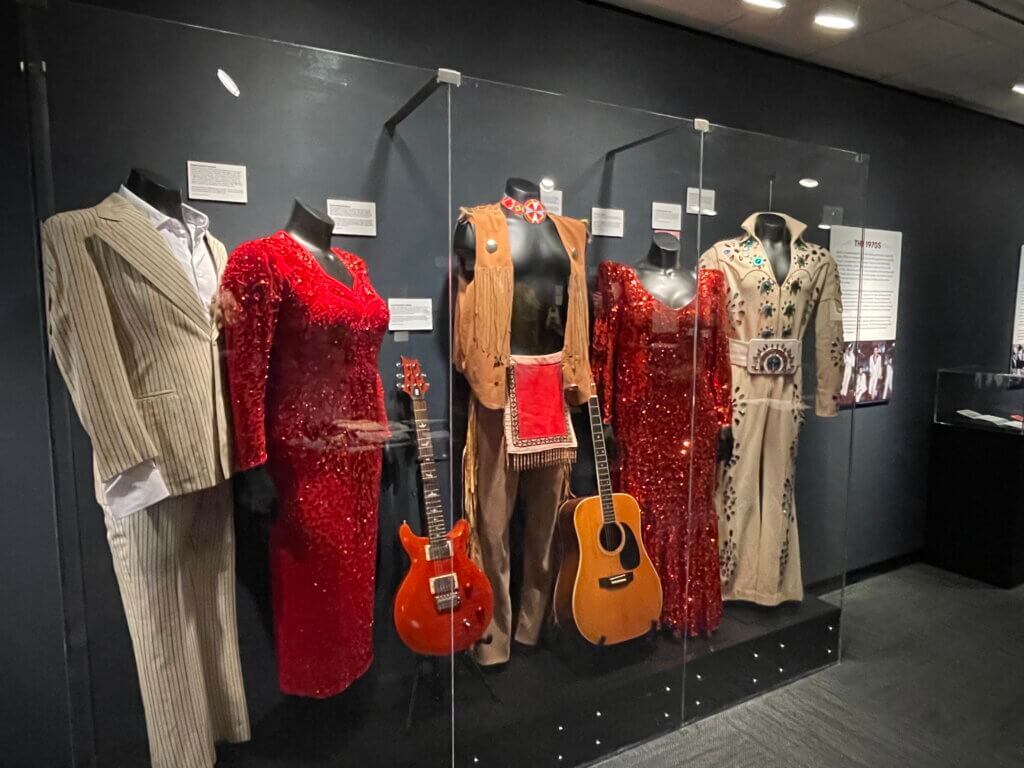
Music America at the Lyndon B. Johnson Presidential Library and Museum at College Station Texas
Koko Taylor’s Dress
The first fabulous red dress on the left, here, belonged to Koko Taylor, who belted out the blues with a ferocity rarely associated with female vocalists of her era. Rather than relying on the restrained elegance often expected of women singers, Taylor embraced a raw, commanding performance style—pushing her songs forward with steely determination and a powerful, gravelly voice reminiscent of blues greats such as Big Maybelle and Big Mama Thornton.
Born Cora Walton in rural Tennessee, Taylor moved to Chicago in the early 1950s as part of the wave of African Americans who migrated north in search of economic opportunity. Immersed in the city’s vibrant blues scene, she struggled for years to establish herself before breaking through with “Wang Dang Doodle,” written by Willie Dixon. The song became a major hit and established Taylor as a formidable new voice in electric blues.
In 1975 Taylor signed with Alligator Records, launching a long and celebrated partnership that brought her music to new audiences. With signature songs such as “Wang Dang Doodle” and “Let the Good Times Roll,” Taylor built a career that spanned decades, earning Grammy Awards and international acclaim. Known affectionately as the “Queen of the Blues,” she carried forward the power and spirit of Chicago blues well into the twenty-first century.
Dress on loan from the Delta Blues Museum.
Etta James’s Dress
Etta James possessed one of the most powerful and emotive voices in American music. At a time when the worlds of blues, rhythm and blues, and early rock & roll were dominated by male performers, James proved her extraordinary range with classic recordings such as “The Wallflower” (aka, “Roll with Me, Henry”), “I’d Rather Go Blind,” and “Tell Mama.”
Drawing on blues, gospel, and soul traditions, James developed a distinctive sound defined by its raw intensity and emotional honesty. Her music could move effortlessly from the grit of rhythm and blues to the elegance of ballads like “At Last,” one of the most enduring recordings of the twentieth century.
Although she did not always receive the same level of recognition as some of her contemporaries, James’ influence on later generations of artists has been profound. Singers ranging from Janis Joplin to Beyoncé have drawn inspiration from her vocal style and emotional depth. In the 2008 film Cadillac Records, Beyoncé portrayed James, introducing her remarkable story and music to a new generation of listeners.
Dress on loan from the estate of Etta James.
Inspiring Icons
Taken together, these objects remind us that women have not been peripheral figures in American music history—they have been central to it. I’m reminded of this anew, and inspired, every time I go and move the exhibit to its next stop. From the blues stages of Chicago to the pop charts of the 1960s, from Motown’s polished harmonies to the rise of MTV and the global pop era, women have shaped not only the sound of American music but also its style, business models, and cultural meaning.
The dresses worn by Nancy Sinatra and Madonna reflect moments when female performers used fashion, performance, and media to define new identities on their own terms. The costume associated with Mary Wilson and the Supremes speak to the power of image, discipline, and cross-cultural appeal in an era of social transformation. The dresses connected to Koko Taylor and Etta James remind us that women in the blues and R&B traditions brought unmatched vocal authority to genres that laid the foundation for rock & roll, soul, and contemporary popular music.
Each artifact in Music America tells a larger story. When viewed through the lens of Women’s History Month, these pieces collectively underscore how women have challenged expectations, expanded opportunity, and redefined what leadership in music can look and sound like.
We’ve barely scratched the surface of the women included in Music America. The exhibition spans more than 250 years of American history, and women’s voices resonate throughout that timeline. These costumes offer only a glimpse—but they invite us to keep listening, to look more closely at the stories embedded in the music, and to recognize the generations of women who have helped create the soundtrack of American life.
Melissa Ziobro
Director of Curatorial Affairs
Bruce Springsteen Center for American Music
Monmouth University
March 16, 2026