It was a much-anticipated football weekend for our tiny Bruce Springsteen Center for American Music team, as our staff has 49ers, Seahawks, AND Rams fans on it. Yours truly, personally, is most interested in watching football when Taylor Swift is in the stadium. Suffice it to say, this weekend, I was mostly thinking about the forthcoming Super Bowl halftime show, which Bad Bunny will headline.
For those who don’t spend their days toggling between Billboard charts and Spotify playlists, for some classic rock enthusiasts—Bad Bunny might still feel like an interesting choice for the most-watched musical performance in American television history. In the weeks following the announcement that he would perform, that unfamiliarity translated into predictable blowback, with some questioning the decision online and lamenting what they see as a departure from “traditional” halftime show fare.
Such reactions echo earlier moments in Super Bowl history, when other artists outside the dominant pop-rock canon were met with skepticism as well. But to frame Bad Bunny as an overnight sensation or undeserving of the honor would be to misunderstand both the artist and the longer musical story that brought him to this moment.
Born Benito Antonio Martínez Ocasio in Vega Baja, Puerto Rico, Bad Bunny emerged in the mid-2010s as part of a new generation of Latin artists who came of age online. He first gained traction through SoundCloud, posting tracks that blended reggaetón, Latin trap, and hip-hop with a DIY ethos that resonated far beyond the island. His breakout collaborations—most notably with J Balvin and Cardi B—introduced him to mainstream US audiences, but his solo work quickly established him as something more than a crossover novelty. Albums like X 100pre (2018), YHLQMDLG (2020), and Un Verano Sin Ti (2022) were not only commercial juggernauts; they were cultural statements, unapologetically rooted in Puerto Rican identity, language, and politics.
Bad Bunny sings almost entirely in Spanish, resists traditional gender norms through fashion and performance, and has been outspoken about issues ranging from LGBTQ+ rights to the mishandling of disaster relief in Puerto Rico after Hurricane Maria in 2017. In other words, his rise challenges several long-standing assumptions in the American music industry: that English is essential for mass appeal, that Latin artists must dilute their cultural specificity to succeed, and that pop stardom requires political neutrality. By any measure—streaming numbers, sold-out stadium tours, GRAMMY wins—Bad Bunny has proven those assumptions obsolete.
His forthcoming appearance on the Super Bowl halftime stage, then, is not just a personal milestone. It represents the latest chapter in a much longer, often uneven history of Latin music in the United States—a history marked by innovation, influence, marginalization, and, increasingly, recognition.
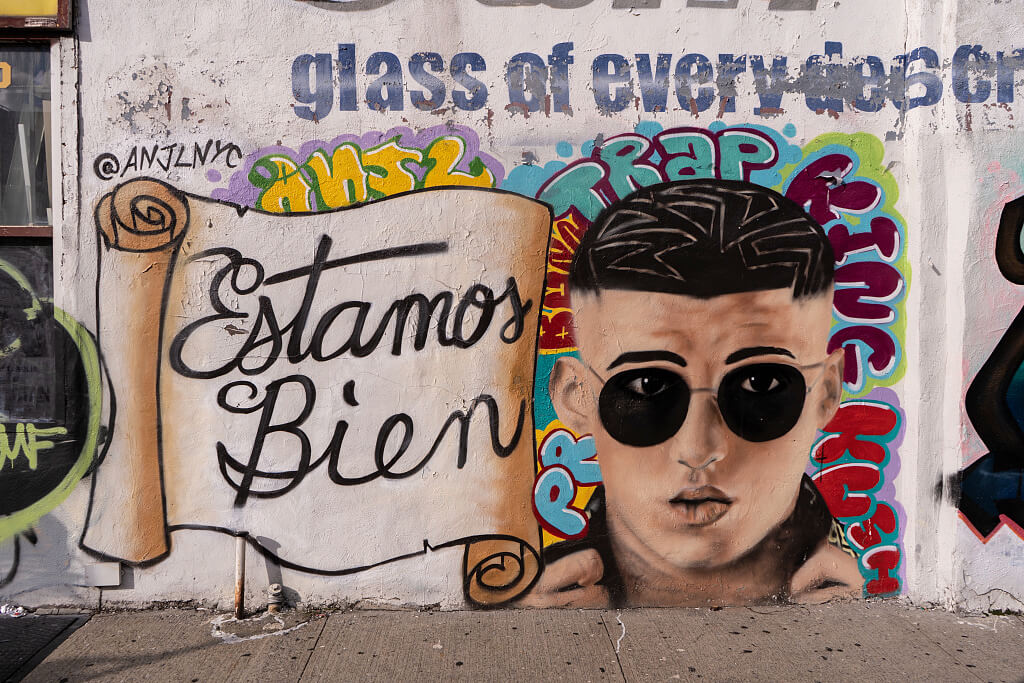
Mural of Bad Bunny, Wilson Ave. at Myrtle Ave., Brooklyn. Photo by Camilo Vergara / courtesy Library of Congress
Latin music has been part of the American soundscape for well over a century. In the early twentieth century, Cuban and Puerto Rican musicians helped shape popular dance music through genres like rumba and mambo, particularly in cities such as New York. Figures like Desi Arnaz, who brought Afro-Cuban rhythms into American living rooms via I Love Lucy in the 1950s, played a key role in familiarizing mainstream audiences with Latin sounds—though often in ways that either softened, or exoticized, their origins.
The postwar era saw the rise of Latin jazz, with artists like Machito, Tito Puente, and Mario Bauzá fusing Afro-Caribbean rhythms with big band swing and bebop. These musicians were not operating on the margins of American music; they were in dialogue with it, influencing and collaborating with jazz greats while carving out vibrant scenes of their own. Yet their contributions were frequently siloed as “Latin” rather than integrated into broader narratives of American musical innovation.
The 1960s and 1970s brought new forms of visibility—and new challenges. Santana’s performance at Woodstock in 1969 remains one of the most iconic moments in rock history, introducing millions to a sound that blended blues-based rock with Latin percussion and spirituality. Around the same time, New York became the epicenter of salsa, a genre forged by Caribbean immigrants navigating life in the United States. Artists on the Fania label—Willie Colón, Celia Cruz, Héctor Lavoe—used salsa as both celebration and social commentary, giving voice to diasporic experiences that were rarely reflected in mainstream media.
Despite these successes, Latin artists continued to encounter structural barriers. Radio formats, record labels, and award categories often segregated Latin music from “pop,” reinforcing the idea that it was niche rather than foundational. Even when Latin sounds dominated dance floors and influenced mainstream hits, credit and visibility did not always follow.
The 1990s marked a turning point, with the so-called “Latin pop boom.” Artists like Gloria Estefan (featured in our “Music America” exhibit), Ricky Martin, Jennifer Lopez, and Shakira achieved massive crossover success, aided by English-language releases and high-profile performances—most memorably, Martin’s appearance at the 1999 GRAMMY Awards. While this era expanded opportunities and visibility, it also came with expectations of assimilation. Success was often contingent on translating one’s sound, image, or lyrics to fit existing pop frameworks.
Reggaetón’s rise in the early 2000s complicated that model. Rooted in Panama, Puerto Rico, and the Caribbean diaspora, reggaetón drew from reggae en español, hip-hop, and dancehall to create a sound that was both global and distinctly local. Initially dismissed by industry gatekeepers—and even criminalized in Puerto Rico—reggaetón nevertheless flourished through underground mixtapes, clubs, and radio. By the time artists like Daddy Yankee and Don Omar broke through internationally, the genre had already built a massive, self-sustaining audience.
Bad Bunny is a product of that lineage, but he also represents its evolution. Unlike earlier crossover stars, he has not needed to translate himself for mainstream US audiences; the audiences have come to him. Streaming platforms, social media, and shifting demographics have reshaped the musical landscape, making it possible for a Spanish-language artist to top US charts without compromise. In this sense, Bad Bunny’s success says as much about changes in American listening habits as it does about his own artistry.
Which brings us back to the halftime show. Long positioned as a celebration of mainstream American pop and rock—often featuring legacy acts or carefully curated hitmakers—the Super Bowl halftime show is as much a cultural barometer as it is entertainment. Bruce Springsteen’s own 2009 halftime performance, which leaned heavily on Born to Run and the communal power of rock and roll, underscored how the stage has historically been used to affirm shared national myths and musical touchstones. Who is invited onto that stage, and what they are allowed to present there, reflects evolving ideas about whose music counts as “American.”
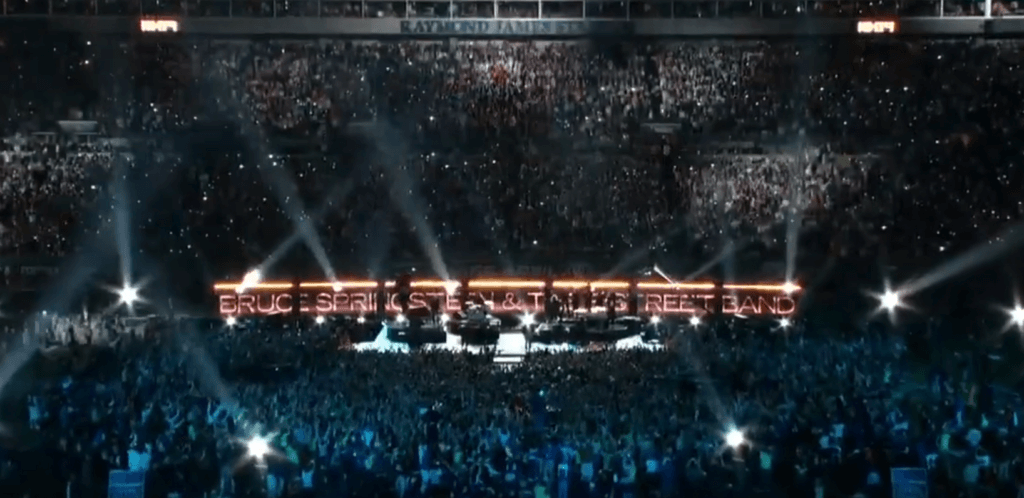
At the outset of his performance, Bruce jokingly encouraged the audience to “step back from the guacamole dip,” “put the chicken fingers down,” and “turn your television all the way up.” Courtesy NFL
Bad Bunny’s presence on the Super Bowl stage signals a widening of that definition. It acknowledges that Latin music is not an add-on or trend, but a central thread in the nation’s musical fabric—one shaped by migration, exchange, and creativity across generations. For a Center dedicated to telling the story of American music in all its diversity, that recognition matters. It affirms what history has long shown: that American music has always been multilingual, multicultural, and in constant conversation with the world beyond its borders.
Whether you’re tuning in for the football, the commercials, or—like me—any celebrity cameos in the stands, this halftime show invites viewers to hear the familiar anew. It is a reminder that the sounds filling our stadiums, airwaves, and playlists today are the result of decades of movement, struggle, and innovation. And that, in itself, is worth watching, even if you’re not a huge sports fan.
For further reading, I highly recommend Leila Cobo’s Decoding “Despacito”: An Oral History of Latin Music (2021). The book traces the evolution of Latin music through the stories behind 19 landmark songs, from “Feliz Navidad” to “Malamente.” Drawing on interviews with artists, producers, and industry executives, the book offers an insider’s view of how these songs were created—and how their success reshaped the cultural and commercial landscape of popular music.
Melissa Ziobro
Director of Curatorial Affairs
Bruce Springsteen Center for American Music
Monmouth University
January 20, 2026