As Black History Month begins, I’m reflecting on some of the amazingly talented Black musicians in Bruce Springsteen’s bands in the 1970s and beyond. These are stories we at the Bruce Springsteen Center for American Music (BSCAM) will center in our new building’s exhibits year-round, not just during affinity months, because they are not just Black History, they are US history; they are NJ history; and they reflect the rich, collaborative, and groundbreaking musical culture of our state.
Georgia of the North
Why is the racial composition of Bruce’s bands noteworthy?
New Jersey’s history with race is long, complex, and often contradictory. Despite its reputation as a Northern state aligned with abolition, New Jersey was the last in the North to pass a gradual abolition law in 1804, leaving many Black residents bound in systems of unfreedom for decades. Throughout the nineteenth and twentieth centuries, segregation, housing discrimination, and economic inequality shaped daily life across the state, culminating most visibly in major civil disturbances in Newark in 1967 and Asbury Park in 1970.
At the same time, Black communities built enduring cultural, religious, and artistic institutions, and music in particular became a space where interracial collaboration could occur even as broader social barriers persisted. This tension between exclusion and creativity forms an essential backdrop for understanding New Jersey’s musical history and the significance of integrated artistic spaces.
For more, see my colleague Dr. Hettie Williams’s 2024 book The Georgia of the North: Black Women and the Civil Rights Movement in New Jersey.
All that being said, it WAS significant that Bruce welcomed Black musicians into his bands. And they did receive blowback. As Bruce noted in his autobiography, Born to Run, “If you travel for years in an integrated band, you see racism in action. In the early seventies it was a few schools that didn’t want us to bring our Black singers. Then on the road with E Street it would…come out of the muck.” He tells stories of Clarence Clemons being called racist slurs, or fights breaking out because whites didn’t like David Sancious being on their beach. It’s unfortunate, it’s unpleasant, and it’s wrong, but it’s history we need to remember lest we repeat it.
For now, though, let’s meet, and celebrate, just a few of the Black members of Bruce’s bands.
Barbara Dinkins Gunter
Barbara grew up in Asbury Park, singing at Good Hope Baptist Church. She and her friend Delores “Dee” Holmes joined The Bruce Springsteen Band in 1971 after answering a newspaper ad for two female gospel singers.
Gunter discusses answering Bruce’s call for “girl” singers in an oral history with Melissa Ziobro, October 2023. Courtesy BSCAM.

Courtesy Asbury Park Press.
As she recalled, Bruce said, “‘you’ve got it.’ He said, ‘you’ve got the job.’ And everyone was welcoming to us. Everyone was kind. It was as if it was a family. That’s what I really liked. And I also gravitated towards it because it was a very wholesome atmosphere. And even to this day, I’ve never been a drinker, smoker, or no recreational drugs. I gravitated towards them because they were so clean cut and so wholesome, and they cared.”
Barbara left the band to devote her time to gospel music, her original calling.
Delores “Dee” Holmes
Delores “Dee” Holmes grew up in Asbury Park and, like Barbara Dinkins Gunter, developed her voice singing gospel music in local churches. In 1971, she joined The Bruce Springsteen Band alongside Gunter after the two answered a newspaper advertisement seeking female gospel singers. Holmes’s powerful, soulful vocals added depth and emotional resonance to the band’s sound during a formative moment in its evolution, reflecting the strong influence of Black gospel traditions on Springsteen’s early music. As one of the few Black women to perform with a predominantly white rock band in the early 1970s, Holmes helped shape an environment of musical collaboration and mutual respect that stood in quiet but meaningful contrast to the racial divisions of the era.
The Bruce Springsteen Band with Gunter and Holmes, New York City, 1971
Ernest “Boom” Carter
Ernest “Boom” Carter replaced Vini Lopez as the E Street Band’s drummer in February 1974. A childhood friend of E Street Band keyboards player David Sancious, Carter brought to the group a blues-based, jazz-laced drum style inspired by the likes of Billy Cobham and Tony Williams.
Carter was in the E Street Band only a few months before he and Sancious left to form Tone, a jazz fusion trio that included Gerald Carboy on bass. Prior to his departure, Carter made his mark by playing on the title track to Springsteen’s landmark album, Born to Run. The opening drum roll in the song is one of the most iconic in all of rock.
Carter discusses his early musical influences in an oral history with Bob Santelli, April 2017. Courtesy BSCAM.
David Sancious
An original member of the E Street Band, David Sancious made a major mark on Bruce Springsteen’s first two albums, Greetings from Asbury Park, N.J. and The Wild, the Innocent & the E Street Shuffle. His elegantly presented piano work, with roots in jazz and classical music, broadened the band’s musical palette and provided Springsteen with a dynamic keyboard sound from which to build his songs and live performances.
After recording on “Born to Run,” Sancious left the E Street Band in 1974 to form Tone, a jazz-rock fusion band that included E Street Band drummer Ernest “Boom” Carter.
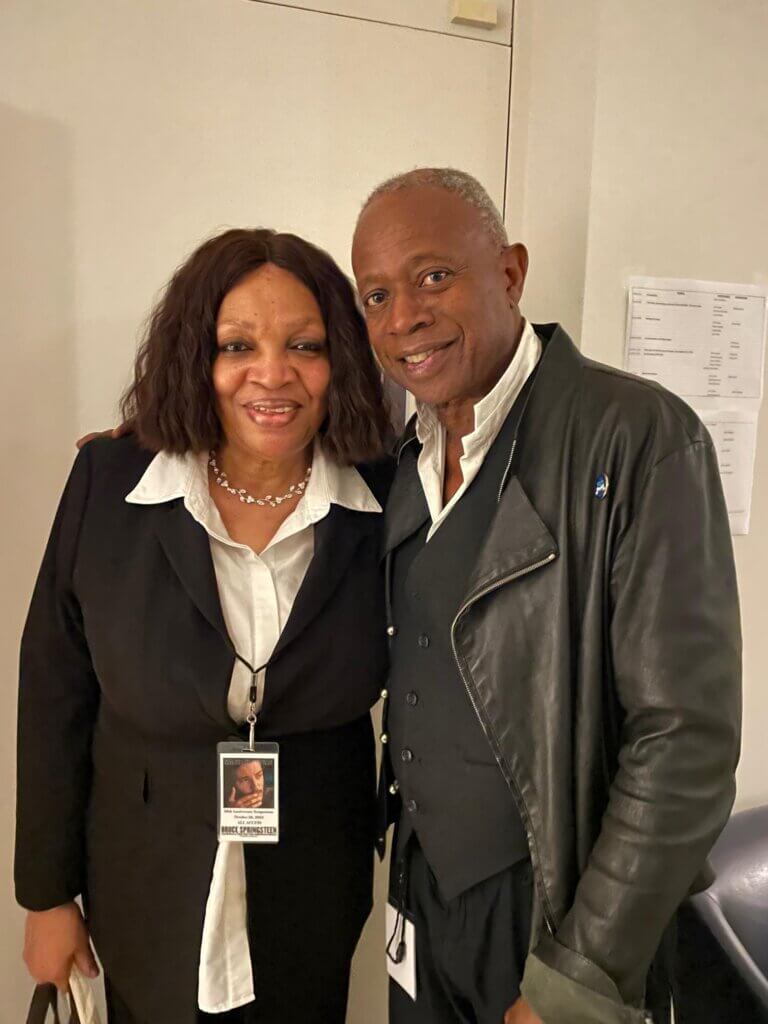
Dinkins and Sancious at the 50th anniversary celebration for The Wild, the Innocent, and the E Street Shuffle at Monmouth University, October 2023. Courtesy BSCAM.
Clarence Clemons
Clarence Clemons joined Bruce Springsteen’s band in 1971 after a chance meeting outside the Student Prince in Asbury Park, an encounter that would fundamentally shape the sound and image of the E Street Band. A classically trained musician with deep roots in jazz, R&B, and soul, Clemons brought a commanding tenor saxophone style that added emotional power and theatricality to Springsteen’s work. His onstage presence and close musical partnership with Springsteen challenged racial norms in rock music during the 1970s, offering audiences a visible and powerful model of interracial collaboration. Clemons’ contributions became central to the band’s identity, with his saxophone lines serving as both melodic counterpoint and narrative voice in some of Springsteen’s most enduring songs.
As Bruce recalled of Clarence in his autobiography, “We were incongruent, missing pieces to an old and unresolved puzzle, two longing halves of an eccentric and potent whole.”
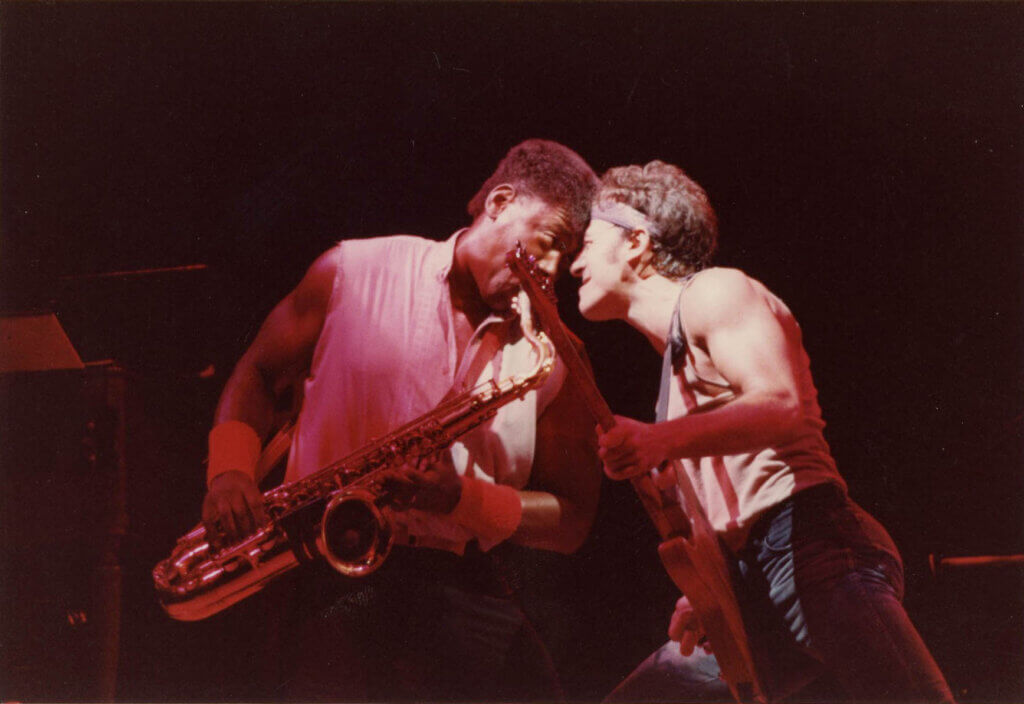
Springsteen and Clemons shared a unique and powerful chemistry onstage that challenged both racism and homophobia. Courtesy Tex and Marion Vinyard Collection, BSCAM.
Jake Clemons
Jake Clemons is an American saxophonist, singer-songwriter, and multi-instrumentalist who joined the E Street Band in 2012, carrying forward the legacy of his uncle, Clarence Clemons. Trained in jazz performance, he forged his own musical path through touring, recording, and developing a solo career marked by introspective songwriting and expansive live performance. In addition to his work with Bruce Springsteen, Clemons has collaborated with artists including Eddie Vedder, Roger Waters, and The Roots. His solo albums, including Fear & Love and Eyes on the Horizon, showcase his commitment to identity, storytelling, and artistic independence.
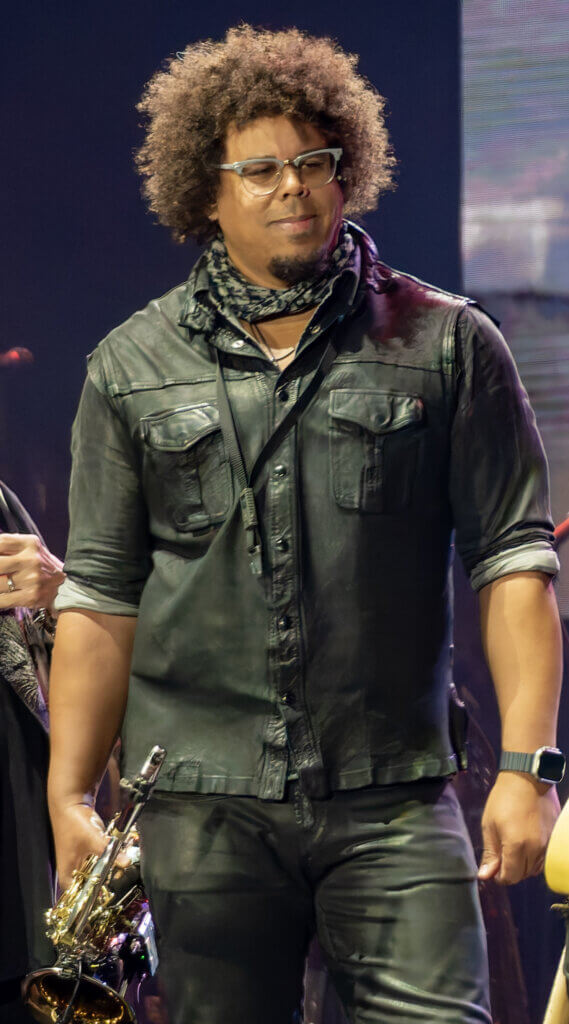
Clemons performs with Bruce Springsteen & the E Street Band at Principality Stadium, Cardiff, May 5, 2024. Courtesy Wikimedia.
New Jersey’s Black Music Heritage Beyond E Street
These artists are a part of a long line of talented Black artists to emerge from the Garden State. To hear more about Black music history in NJ more broadly, catch a replay of the state historical commission’s December 18 program “‘Follow Me’: Preserving New Jersey’s Black Music Heritage.” Speakers included Vincent Pelote (Rutgers Institute of Jazz Studies), Jamara Wakefield (In the Wake TV), Jennifer Souder and Yvonne Clayton (Asbury Park African American Music Project), and me.
Melissa Ziobro
Director of Curatorial Affairs
Bruce Springsteen Center for American Music
Monmouth University
February 3, 2026