Bruce Springsteen made an unscheduled (if highly anticipated) appearance at the Light of Day festivities at the Count Basie Center for the Arts in Red Bank this past Saturday, and both his set list and his political comments from the stage are getting tremendous attention online. But we at the Bruce Springsteen Center are a tiny and very busy team as we prepare for the opening of our new home in the spring, so I try never to write a blog unless I truly have something that I hope is unique and educational to say. Towards that end, I am not going to recap the show (though I will gladly point you to Jay Lustig’s review if you haven’t already read all about it). What I do want to say is this: Bruce’s political comments are nothing new. It’s not my job to tell you to agree with them, but it is my job to document, interpret, and contextualize them.
But first, if you’re not familiar: what is Light of Day?
The Light of Day Foundation was established in 2000 by Bob Benjamin, a New Jersey music industry veteran who was diagnosed with Parkinson’s disease at a young age. What began as a single benefit concert has grown into a multi-day annual festival, raising millions of dollars to support Parkinson’s research and patient care. True to its grassroots origins, Light of Day has always centered music as both a community-building force and a tool for advocacy—bringing together artists, fans, and families affected by Parkinson’s in spaces large and small across New Jersey. The event’s mission and longevity are a reminder that benefit concerts can be more than symbolic gestures; they can be sustained, deeply personal commitments.
And has Bruce played Light of Day before?
Yes—many times. Bruce has been involved with Light of Day since its earliest years, often appearing unannounced, sometimes for a single song, sometimes for a full set. His participation signals his long-standing personal relationships with those involved and a broader pattern in his career of supporting causes tied to illness, labor, and social justice. Over the past two decades, his Light of Day appearances have ranged from stripped-down acoustic performances to high-energy collaborations, reinforcing the idea that this event is not an outlier in his live history, but firmly a part of it.
What did Bruce say this year that has some people up in arms?
From the stage, Bruce spoke forcefully about democracy, freedom, and the responsibilities of citizenship—language that will sound familiar to anyone who has followed his public remarks over the last fifty years. He criticized political leaders he believes threaten democratic norms and emphasized the importance of empathy for immigrants, working people, and the marginalized. Criticizing Immigration and Customs Enforcement (ICE) specifically, he dedicated his song, “The Promised Land,” to Renee Good—a mother of three recently killed in an altercation with ICE agents in Minneapolis.
For some listeners, hearing these sentiments articulated so plainly (whether there in person or seeing it later online) felt jarring or unwelcome; others felt it entirely consistent with the values expressed throughout his songwriting, from Born in the USA to The Rising to Letter to You.
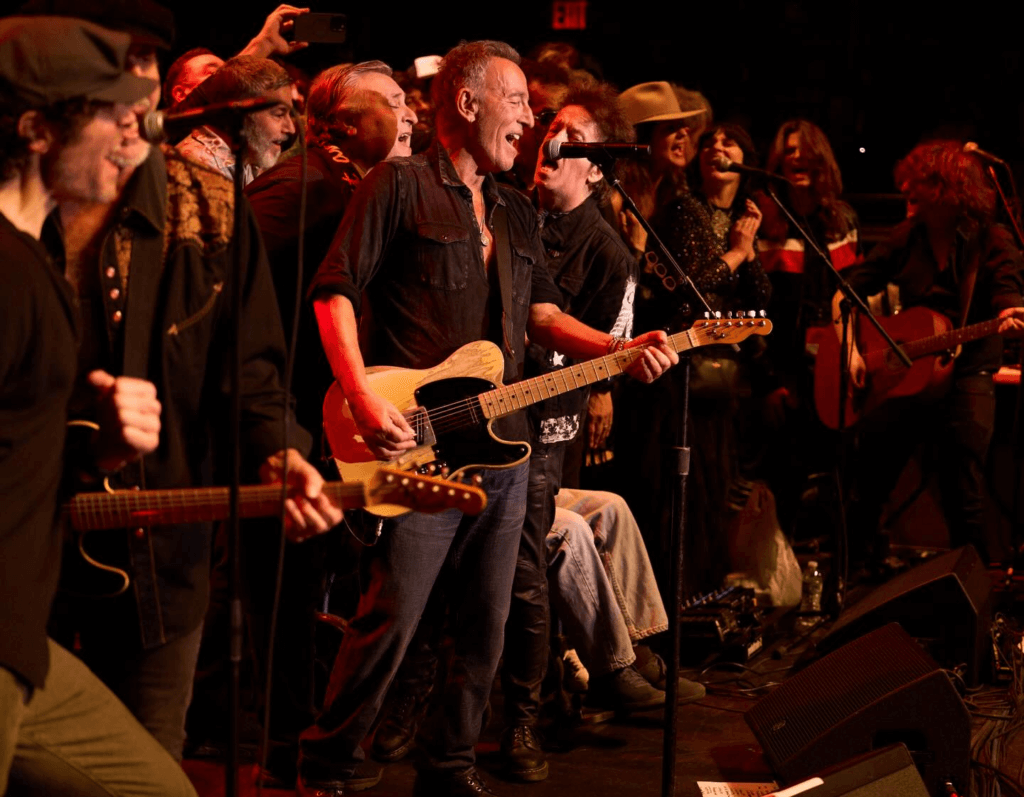
Bruce with other performers at Light of Day 2026. Courtesy Danny Clinch
Is this out of character for Bruce?
No, it is not. What is worth noting, historically, is not the specific phrasing of these remarks but their continuity. Bruce Springsteen has been making explicit political statements onstage for over six decades, whether introducing “The River” with stories of economic hardship, dedicating songs to striking workers, campaigning for presidential candidates, or speaking out against war and inequality. The platform changes, the news cycle accelerates, and social media amplifies reactions—but the core impulse remains the same. As an artist, Springsteen has consistently understood music as a civic act, one that invites listeners not just to feel, but to reckon. As he notes in his autobiography, “I was never going to be Woody Guthrie—I liked the pink Cadillac too much – but there was work to be done.”
Is Bruce unique in using his platform this way?
Again, no. Springsteen’s remarks fit within a long American tradition in which artists across the political spectrum have used music to advocate for causes they believe in. From folk singers and soul artists aligned with labor and civil rights movements, to country musicians voicing patriotism, religious conviction, or skepticism of centralized government power, popular music has always served as a platform for civic expression. These interventions are not anomalies or recent inventions; they are woven into the fabric of American music history itself. Artists have used songs, stages, and public appearances to reflect their values, rally communities, raise funds, and, at times, provoke disagreement. Whether listeners embrace or reject the message, the act of musical advocacy has consistently been part of how artists engage with the world beyond the studio and the stage.
Melissa Ziobro
Director of Curatorial Affairs
Bruce Springsteen Center for American Music
Monmouth University
January 20, 2026