Today in the Curatorial Corner, we’re featuring a guest blog by Kelly C. Ruffel, Director of the County of Passaic’s Department of Cultural & Historic Affairs. On February 11, the Passaic County Board of County Commissioners, in collaboration with the Bruce Springsteen Center for American Music at Monmouth University, announced Born to Run at 50, a landmark exhibition celebrating the 50th anniversary of Bruce Springsteen’s transformative 1975 album Born to Run. The exhibit will be on view from February 26 through July 5, 2026, at the Passaic County Arts Center. It exists in three parts: outtakes from the Born to Run album cover photo shoot by Eric Meola; artifacts from the Born to Run era and Bruce’s Capitol Theatre shows; and video from those shows alongside footage from the September 2025 Born to Run 50th anniversary celebrations at Monmouth University. See more here.
In Kelly’s blog, she’s sharing a bit about the history of the (now demolished) Capitol Theatre, where Bruce played some legendary shows….
Music and performance spaces were central to youth culture throughout the 1960s. As music rooted in civil rights, anti-war protest, and social justice moved from open fields into formal music halls, the attitudes of the generation that grew up alongside the evolving music industry shifted as well.
This transformation was especially visible in metropolitan New York and New Jersey during the 1970s. Folk music remained the heart of Greenwich Village, while the Fillmore East, its rock & roll counterpart in the East Village, closed abruptly in the summer of 1971. Its closure created an opening for a new venue to shape popular culture. A contractual clause had barred performers from appearing within a seventy-five-mile radius for four months after a Fillmore engagement, limiting premier bookings in New Jersey. But two young and ambitious New Jersey promoters, John Scher and Al Hayward, were determined to change that.
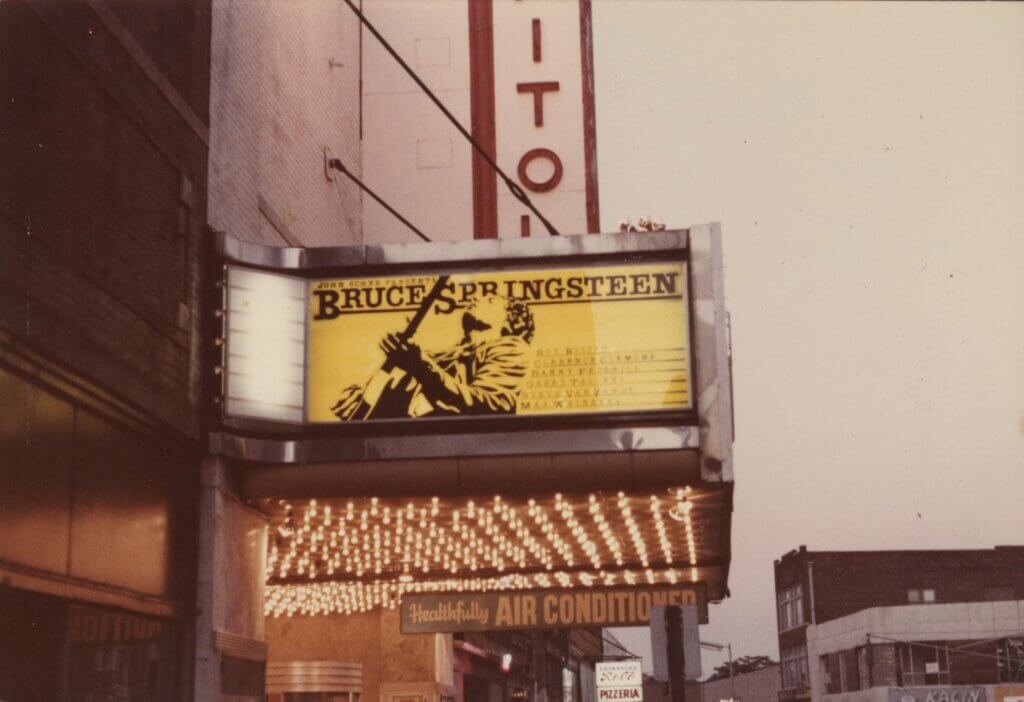
On December 14, 1971, they opened the Capitol Theatre in Passaic. At a time when artists were increasingly performing in arenas, Scher and Hayward proved that intimate venues still mattered—for their sound quality, production value, and atmosphere. Located in working-class Passaic, the Capitol was envisioned as a space that felt independent and youth-driven, a place not run by the adult establishment. It resonated with a generation coming of age amid political and cultural upheaval.
Through Scher’s industry connections, the Capitol hosted major acts including The Rolling Stones, The Who, Prince, and Jerry Garcia. Live radio broadcasts and widely circulated bootlegs further elevated the theatre’s reputation, establishing both the Capitol and New Jersey as essential stops on the touring circuit. Yet one local artist’s relationship with Scher would ultimately define the venue’s legacy.
Bruce Springsteen & the E Street Band were fixtures on the Jersey Shore music scene, famously performing at the Stone Pony. Springsteen and members of the band were close friends with Scher and with fellow Shore musicians Southside Johnny and the Asbury Jukes. They supported one another across venues throughout the state, even as their popularity grew. The Capitol’s location and audience made it distinct. No artist embodied working-class youth more fully than Springsteen, and the theatre offered North Jersey’s factory-town audiences someone who reflected their own experiences and aspirations.
Springsteen performed five times at the Capitol Theatre. On October 14, 1974, during the recording of Born to Run, the band headlined after John Sebastian, originally scheduled as the lead act, chose to open the show after hearing their soundcheck. That night, “Jungleland” was previewed for the Passaic audience.
While the 1978 performances are often considered among the band’s finest, the New Year’s Eve 1977 show with Southside Johnny and the Asbury Jukes remains legendary. Southside Johnny Lyon and his band, who had also emerged from the Asbury Park scene alongside the E Street Band, closed their set by inviting Bruce and members of the band, who had been watching from the audience onstage for the final songs. When the evening ended, Springsteen asked Scher if he, the E Street Band, and the Miami Horns could continue playing into the early hours of the new year. Scher, the musicians, and the crowd eagerly agreed, creating an impromptu performance that became the stuff of local lore.
Diane Robertellio Simko stood at the front of the stage that night. She recalls Springsteen removing the sweater he had worn during the performance and tossing it into the crowd. She caught it and was immediately swarmed by fans hoping to claim a souvenir. With her husband’s help, she managed to hold onto it. This exhibition marks the first time the sweater has been publicly displayed since that unforgettable night in 1977.
When Springsteen launched the Darkness on the Edge of Town tour in 1978, there was only one choice for his first New Jersey stop: the Capitol Theatre. The band performed on September 19 and 20, 1978, with the lineup of Max Weinberg (drums), Garry Tallent (bass), Danny Federici (organ), Roy Bittan (piano), Steven Van Zandt (guitar), Clarence Clemons (saxophone), and Springsteen.
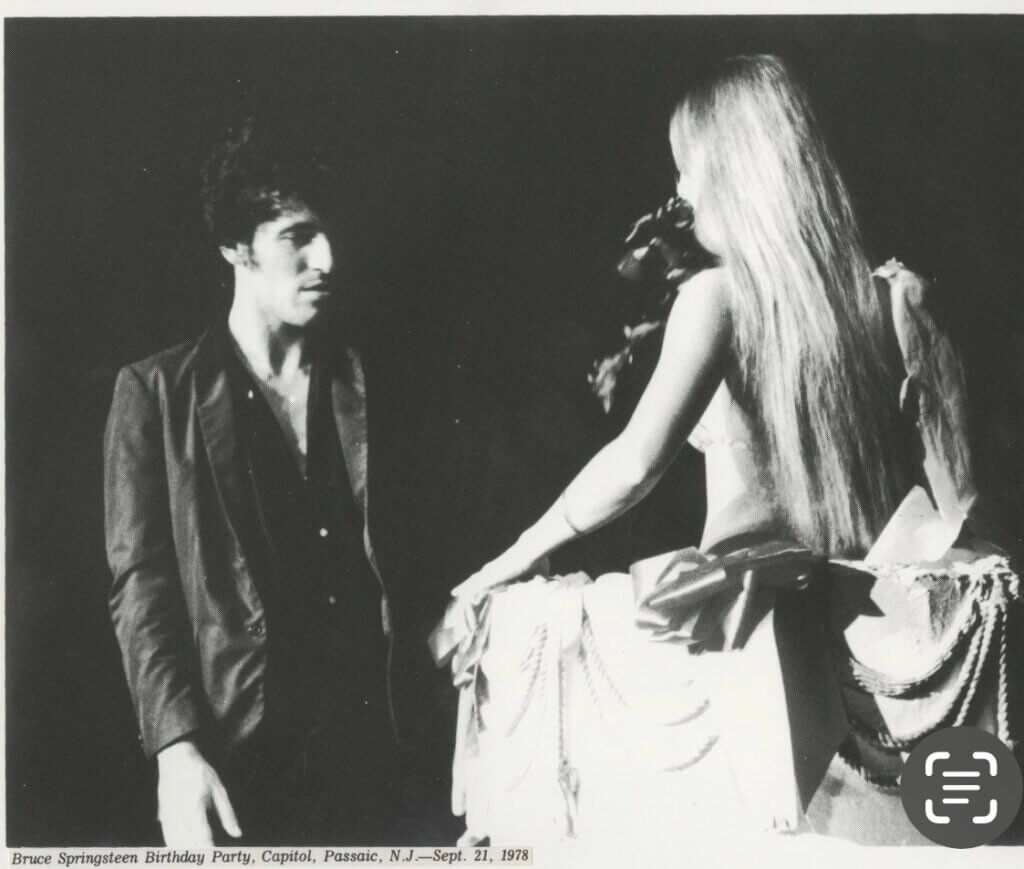
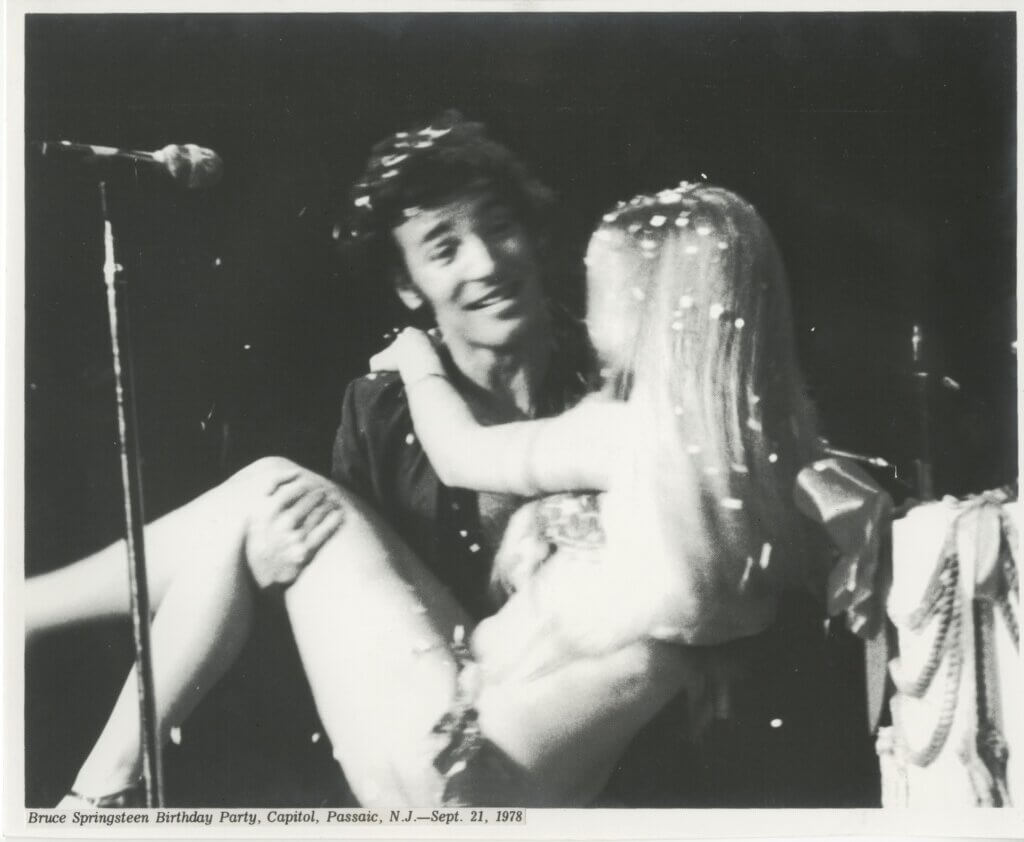
With the support of WNEW-FM and nine additional radio stations, the September 19 performance was broadcast across the Northeast. The show quickly became celebrated as one of the band’s greatest live performances and circulated widely as the bootleg Pièce De Résistance. The sold-out run concluded just days before Springsteen’s 29th birthday, which the band and crew marked with a surprise cake as the audience sang “Happy Birthday.”
Music historians now recognize these performances as pivotal moments that cemented both John Scher and the Capitol Theatre as vital forces in the rock culture of the 1970s and 1980s, alongside venues such as CBGB.
Bruce Springsteen & the E Street Band did not return to perform at the Capitol before it closed in 1989. Yet for those who witnessed the band take the stage there in the 1970s, it was clear: the Capitol Theatre was a stage perfectly suited for The Boss.
Melissa Ziobro
Director of Curatorial Affairs
Bruce Springsteen Center for American Music
Monmouth University
February 18, 2026